Saturday, October 1, 2011

Location-Aware Album by Bluebrain

The National Mall by BLUEBRAIN. The First Location-Aware Album from BLUEBRAIN on Vimeo.

This is a trailer for the "location aware" album by Bluebrain, The National Mall, based on Washington, D.C. As the Pitchfork article that brought my attention to it describes, it's like bringing the soundscape of a video game to real-life. The project appeals to me because I am from Washington, D.C. and have walked around the National Mall to my own mixtape many times. In general, though, I like to coordinate my listening to place, thinking about good road trip mixes for different destinations and the best arrival music to various locations (thanks to the Jim Jarmusch film, Down By Law, New Orleans will always be Tom Wait's Rain Dogs for me).

Here is how Ryan Holladay of Bluebrain describes the project:

We thought, “What if you replace that map within the videogame terrain with the coordinates of an actual map?” In this case, the National Mall. And instead of assigning sounds, like you would in a videogame, to mimic real life, what if you made it musical, or surreal? For instance, as you start at the base of that hill [at the Washington Monument] you hear a single cello and piano. And as you make your way up to the top, more and more instruments keep getting added, to the point where you’re literally at the very top, touching the Monument, and you’re hearing out-of-control blast beats.

Though I have not downloaded the iPhone app and taken the music tour created by the band, one thing I notice and like about the trailer above is that the sense of place is not simply monumental, visiting the major landmarks in the most straight-forward way possible as a tourist would. The approach seems glancing, as with the avatar's experience at the Washington Monument and Lincoln Memorial. Sharing this quirky perspective on place seems like a major contribution to the democratic mapping of Washington, D.C. In a sense, it nurtures the kind of perspective Noah gives us in his post, "The Capitol Who Watches Over All," which opposes the singular conception of the city from the pov of the Capitol.

(All images are screen captures from "The National Mall" video trailer by Bluebrain.)

Tuesday, September 27, 2011

The Capital Who Watches Over All


The U.S. Capitol building sits atop Capitol Hill at the eastern end of the National Mall in Washington, D.C. The Senate Wing of the building was completed in 1800, and the House Wing was completed in 1811. The building is still home to both the Senate and the House of Representatives which together form Congress. The National Capital holds many true and symbolic powers. The majority of the time it holds the most influential and important elected officials of the U.S. Government. However, when it is empty it still seems to be active, watching over the city like a big brother.
As you can see in the picture above, the Capitol is situated in an elevated position looking over the National Mall and the City as a whole. This position makes it visible in nearly every area of the city. Although there is not truthfully a person peering out from inside the capital on a daily basis, it still appears to be watching over the city. Whether they are conscious of it or not, people are constantly in the field of vision of the capital.

The picture to the left was taken by a photographer with the last name Bettmann in the 1940's. Run-down tenements sit in the foreground. In the background, the capitol sits in the direct center, watching every corner of the city. This picture is quite ironic if we interpret the capital as watching over the city. It is watching the people suffer in the crowded tenements yet doing nothing about it. Additionally, the U.S. Capitol is a symbol of the 'American Dream'. The people who inhabit these tenements are not living this dream yet they look at the capitol nearly every day.

Watching over the city, the capital serves the same person as a false security camera. Upon seeing it, the viewer adjusts their behavior, thinking someone is watching. The capitol is just a more primitive form of false surveillance, causing people to take just a little more consideration. This surveillance connects to the concept of a "Smart City" which we discussed in class a few days ago. The Capitol helps to make Washington D.C. a "smart city" in a sense, always surveying everyone and everything in sight.

Here is a video History of the United States Capitol.

This idea of constant surveillance connects to the Panopticon style prison.


The Biggest Parking Lot


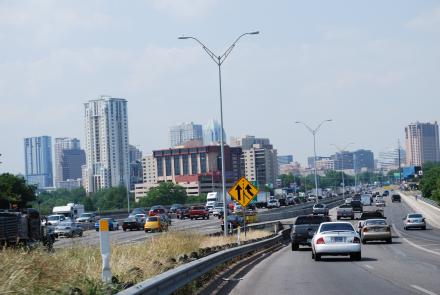
Its 5:30. I’m trapped on I-35, known at the “worlds’ largest parking lot”. I have been stuck in traffic for over 30 minutes and I have to be downtown in less than 10 minutes with 3 miles left until I can exit…FML!

Traffic is part of our lives for those that live in Austin. Heavy traffic stimulates anger and frustration from many impatient drivers with a busy schedule. Traffic congestion is very heavy during the time of rush hour, from 6- 9am and 4-7pm on weekdays, as people are driving to and from work. Even though traffic in Austin is not as bad as other major populated cities like New York City, sitting in traffic is still very annoying.

In modern society, time is money. People are constantly running around: getting to work, getting home, going to school, picking someone up, having a meeting somewhere, going to the movies, etc. Therefore, speeding has significantly increased because people are always in a rush to get to where they need to be.

Interstate 35 is the most annoying place to be when there is traffic. There is no room to breathe. Joe Taylor a traffic reporter for News 8 Austin describes that I-35 is "designed for a small town, and [Austin] has grown into a very large city." Since 2000, Austin's population growth has increased 15.4 percent in 2008.


As the city of Austin continues to grow, the roadways become smaller and tighter during rush hour as more people are driving on the road. According to Katherine Gregor, a journalist for The Chronicles, "the metric used to document congestion is a road's volume-to-capacity ratio, which compares the existing volume of traffic (flow rate) to a street's real capacity." A capacity of .8 or lower means that there is less traffic. However, downtown I-35 is said to have a capacity of over 1.0! I-35 is not the only roadway in Austin with high traffic congestion: Loop 360, Mopac, and Lamar.

Austin's traffic continues to get worse because of the lack of an alternative form of transportation. Capital Metro is one form of an alternative form of transportation that helps to ease traffic in the city; however, this form of transportation is not very popular to the public. In addition, businesses and shops in Austin are often very far apart and it is only convenient to drive, rather then riding a bike or walk.

So what is The Austin Department of Transportation doing in response to driver's frustration to the increase traffic?

The Austin Department of Transportation is constantly readjusting the route of city buses to make it more convenient to the public. The city has also built a Capital MetroRail that runs from downtown Austin to the norther part of Austin. According to Robert Spillar, director of The Austin Department of Transportation, they are trying to build "new sidewalk and bicycle improvements and advocating that people simply drive less, both regionally and in town."

How does traffic affect Austinites?

Some of the obvious reasons are that traffic causes people to be late to their activities and makes people anger. However, traffic also plays a role in car accident. Many people become reckless drivers when they are angry and frustrated in traffic: changing to the faster lane or using the shoulder to cut through traffic. Traffic accidents are heard almost everyday on the radio (KLBJ) and Joe Taylor also updates his Facebook about the incidents. In addition, businesses are also affected by the traffic. High traffic in an area can cause businesses to lose valuable customers because people tend to avoid the cluster of cars.