Sunday, October 28, 2012

Seaholm Power Plant

*NOTE: ALL MUSIC INCLUDED IN THE VIDEO WAS RECORDED ON SITE AT THE SEAHOLM POWER PLANT
            Seaholm Power Plant was operational from about 1950 till it was decommissioned in 1989, in part due to the detrimental environmental impact it had upon the surrounding area of Southwest Austin. Since then it’s been used as a venue for a wide variety of events such as concerts, car shows, parties, and arts exhibitions. There’s been nothing but positive feedback on using the structural space and surrounding area like this, everybody loving the unique architecture of the plant and even just the idea of using this old building that used to power the city but is now an outlet that helps to power the creativity that Austin has to provide. But in 2000 the city of Austin created a master development plan that is soon to commence, soon to create a new part of Austin dubbed the Seaholm district. The plan is to build a new high rise apartment complex, several retail stores, offices, restaurants, a public library, and an open field space that looks over Lady Bird Lake. Such vision to take a formerly industrial area and turn it into a vibrant urban space has been applauded by many supporters. But then are those that disagree, that are disappointed that it will no longer be a landmark that doubles as a space that is a great channel for the unique Austin culture to pass through. Of course then the demographics discussion begins: what kind of people are going to be in this new area and how will it affect the city. I believe that that the repurposing of the power plant into the Seaholm District is detrimental to Austin because, while it creates a municipal space while preserving the building, the plant has become known as a landmark central to Austin’s personality.
            The critics’ argument against the remodeling of the Seaholm Power Plant and surrounding space is that it will detract from the special personality of Austin. As well as this, they contend that, by ceasing to act as a concert venue, it diminishes the value of Austin as the live music capital of the world. The plant has long been present in the hearts of Austinites, its distinct red neon sign a memory for many. If not, the local icon can be found in countless photographs that attempt to capture the spirit of Austin through the sign. Seaholm’s importance as a landmark, regardless of its lack of use, is widely recognized. Proposing its demolition would be akin to suggesting that we destroy the University of Texas Tower. This is why critics, myself included, believe that the power plant should remain as it is and continue to host musicians and exhibitions alike in order for people to be able to reflect upon a historical piece of architecture while experiencing Austin’s distinct culture.
            Most supporters of the urbanization plan agree that it would be disgusting if the power plant was to be entirely demolished. But they believe that it would be more beneficial if the area where the plant is located were to transform into a modern space where people will be able to interact and live. Their argument is that this space has great potential to bring in revenue for the city without changing an existing area. Many are especially excited about the announcement of the addition of a Trader Joe’s in the Seaholm District. In addressing the loss of the music scene at the power plant, some argue that the location of the nearby venues Austin Music Hall and Austin City Limits Studio are sufficient in providing a place for the Austin music to thrive.
            No doubt the subject of what demographics will be present in this new area must be addressed. Unfortunately, I believe that the Seaholm District will come to be known as a secluded area of town that belongs to the upper class. The new residencies are targeted for the upper class, so now doubt the close by events will cater to them for their convenience. The only consolation that can be found is that it is not similar to the situation of gentrification in East Austin since there is nobody currently living in the soon-to-be neighborhood. Still, we can predict that there will be not much diversity to be seen in the Seaholm District.   


More Than Just a Grocery Store


Since Whole Foods first opened its doors 32  years ago in Austin, Texas it has become a community gathering place for a wide variety of Austinites.  From the moment you walk in the doors you are sure to encounter a suburban mom on her weekly grocery trip, a UT student picking up healthy snacks, a runner stopping in for a smoothie, or a local musician gathering sustenance before they head to Sixth Street for a show. Whole Foods has expanded outside of the grocery store norm by offering cafĂ© eateries and several communal dining spaces both inside and out. Located on Lamar between 5th and 6th Street Whole Foods is easily accessible for any Austinite to satisfy their hunger pains. 
By entering through either the street level large sliding glass doors or by rising up via the escalator from the parking garage you are enveloped into a world of chatter and bustle. You arrive to the welcoming aroma of an eclectic variety of food sure to satisfy any Whole Foods patron. The indoor communal dining area allows you an opportunity to share a table and conversation with any variety of guest or if you prefer the sounds of chirping birds while watching traffic rush by on Sixth Street and Lamar the outside patios are an excellent choice.

Despite the store’s focus on creating a community gathering space for people to enjoy fresh and local cuisine they also offer a wide variety of grocery, pharmaceutical, and clothing products. The founder, John Mackey, wanted to open a local natural grocery store that specialized in natural supplements and organic local food while having the feel of a small community general store. The store has become a speciality in pharmaceuticals with expansive aisles housing natural products and a trained pharmacist on hand to help. The store also features a large fresh produce section housing local fruits and vegetables, an aisle specializing in the grinding of fresh nut butter, a seafood counter marketing the freshest fish in Texas, and several more aisles with natural snacks, cereals, and beverages for purchase. 

Throughout their many nationwide stores Whole Foods has created very strict guidelines for the quality of the products in their stores. Their quality rule states that they will only fill their stores with natural foods that meet the following guidelines: minimally processed foods free of hydrogenated fats, free of artificial colors, flavors, sweeteners, and preservatives. Whole Foods also has a strict guideline about the humane treatment of the animals their products come from. Having strict food and product guidelines has made Whole Foods an attractive destination for many Austin citizens. 
In the year of 1981, less than a year after its opening, Whole Foods role of importance in the community of Austin was proved. Austin suffered its worst flood to date on May 24, 1981 leaving Whole Foods suffering severe water damages forcing them to close their store. Since Whole Foods was already lacking funding, and they were not insured, there was no possibility of the store being repaired and reopened. The Austin community including: neighbors, other Austin business owners, and employees banded together to repair the damage done by the flood to reopen Whole Foods in twenty-eight days.
Being located in a central part of Downtown Austin, Whole Foods is easily accessible from the UT campus, surrounding downtown apartments, the suburban Westlake neighborhoods, and walking distance from Zilker Park. The ability to access Whole Foods from almost any part of Austin allows for a wide draw of citizens to enjoy this multi-use friendly urban space.

Friday, October 26, 2012

Society and HBCUs: A Noteworthy Partnership

The musical introduction is by Bobby Bradford, alum of Huston-Tillotson University.


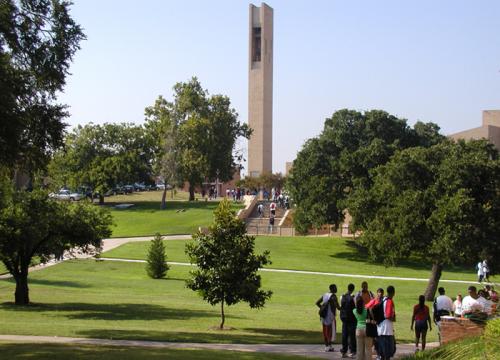
Black students. Black professors. Buildings that bear the names of prominent blacks in the community. A thirst for knowledge and culture unquenchable by any other establishment. This is a list of things one might experience walking around the campus of Huston-Tillotson University, or HT, the only historically black college/university in Austin. Since its establishment in 1881, the convergence of Samuel Huston College and Tillotson College has always stood for more than just another college because it represents the strive for excellence in the Black community.  Austin has so much racial and socioeconomic segregation (as seen through the strategic placement of Interstate 35) that it benefits from HT because of the culture, history, and opportunities it presents to not just Blacks, but everyone.


The cultural aspect of HT is also one that is of benefit to society. HT offers both sororities and fraternities that have strong roots in African American history and advancement. These sororities and fraternities, while they act as sister and brotherhoods to establish lifelong friendships, bring forth a tradition that spans back almost a century – stepping. Step shows put on by different Greek organizations throughout universities and throughout cities are to exemplify a non-academic standard of excellence. Stepping represents a non-traditional form of dance and expression highly common in the Black community that dignifies a sense of unity within Black Greek life that be seen throughout the university as a whole which trickles into the life and culture of the city.