Showing posts with label Music. Show all posts

Thursday, October 25, 2012

A Walk in the Park: The Story Of Zilker Park in a Podcast

"Long after our cities are condemned and destroyed, our parks will stand as a testament of the serenity of our weekends to distant trespassers."
-Benson Bruno

In the 1960s, Jane Jacobs, an activist interested in urban communities, theorized that parks, contrary to most municipal politicians’ beliefs, are not beneficial to a city. Jacobs wrote that parks are not useful because they do not offer a city center for diverse events and people to come together and bond the city. Jacobs, however, never came to Austin, and never saw Zilker Park, a hub of culture that gives Austin a unique flavor and soul. 


Jacobs believes that streets are beneficial to cities because they house businesses and therefore communities. However, Zilker Park is home to many small local businesses. Near Barton Springs, there is a small kayak and canoe rental place. I asked the people working there a couple of questions about the park and their work. The business had been in operation for a long time, which is a testament to Zilker's year-round popularity. The workers also had positive things to say about the variety they see in their customers. 

The boats of Zilker Park Kayak Rentals. Source: http://www.freeaustinfun.com


Zilker is indeed a diverse community. Located in the heart of the city, Zilker attracts people of all kinds. On one given Sunday, many different people were out enjoying the natural beauty the park offers. A Hispanic family celebrates a birthday at one of the picnic tables, two Chinese students from UT talk as they walk the Town Lake trail, and an elderly white couple orders food from a snack stand. Zilker’s diverse visitors prove Jacobs wrong yet again. Neighborhoods tend to house only one demographic, while Zilker has served Austinites of many varieties since it opened in the 1930s. 


Diverse group of college kids enjoy a picnic in Zilker
Source: http://thesiftedlife.files.wordpress.com

Zilker is valuable to Austin because it offers so many different activities for the Austin community. City wide events like the Kite Festival are held there, along with smaller events like soccer games and beach volleyball tournaments. Austin was named one of the top ten fittest cities in America, and Zilker Park helped create that image.  Zilker Park is home to the famous Town Lake Trail, which attracts about 1.5 million visitors a year. Every day, people in the Austin community run and bike the ten mile loop. Big fitness events like the Livestrong Bike Challenge are hosted by Zilker, and the sounds of people finishing the strenuous race for the cure could be heard all over the park. 


Another feature of the park is Barton Springs. Barton Springs is a natural spring, and people have been swimming there since the 1940s. Though the springs average a chilly 68 degrees Fahrenheit, the people of Austin come from far and wide to enjoy the springs. Barton Springs was segregated for a short period of time, but soon the spring was entirely open to all Austin citizens, illustrating Austin’s socially innovative history. Interestingly enough, one side of Barton Springs requires a fee to enter, and the other, less developed side is free to the public. Some regulars say that there is a new disparity now days, as teenagers and young adults congregate on the free entry side while families and older people prefer the calm of the pay to enter half of the springs. Despite this de facto separation, people of all varieties are here on this lovely fall day enjoying the chilly waters. 


The event that has gained Zilker Park the most fame is the Austin City Limits Musical Festival. Each fall, Zilker hosts about 90 musical performers and roughly seventy thousand music fans from Austin and beyond. Nicknamed ACL, it captures Austin by featuring local artists and selling food exclusively from local Austin restaurants, often under the “Keep Austin Weird” moniker, In the past, the festival has been criticized for not being racially diverse in the artists included in the line up. However, in recent years, the festival has diversified and invited a wide range of artists, including Kanye West, Norah Jones, Stevie Wonder and Esperanza Spalding. With it’s widening pool of genres, ACL has also attracted a more diverse group of attendees. While the high ticket price keeps some people away, most people don’t mind paying high prices to be immersed in Austin’s lively music scene. The festival also attracts a wide age range: older music fans flock to here old favorites like the Eagles while kids younger than ten can get in free with a ticket holding adult. Thanks to this policy, the park fosters an appreciation of the unique Austin music scene in people from a young age. Environmentally, the festival has tried to minimize it’s footprint by selling shirts made from recycled materials and selling boxed water rather than bottled water. Each year, the festival changes and improves, impacting Austin in a special way. The people I interviewed at the eleventh annual festival had nothing but positive things to say about the festival. 


View of Austin skyline from Zilker during ACL. Source: http://www.mymilestone.com/


Zilker Park’s most positive attribute is it’s availability to kids. Jacobs believes that kids benefit from a street focused community because it offers free space to grow and play. However, Zilker Park does just that, but in a natural environment. Zilker features a playground, which is free and open to all children. A small train called the Zilker Zephyr runs a small loop around the park every thirty minutes for a small price, which is often a favorite amongst the kids. 
The kids benefit from this environment more than they would from a city street environment because the space is designed for children and is exclusively designated for them, keeping them safe and happy. As kids turn into kids at heart, they can use other aspects of the park for recreation. Teenagers flock to the park on sunny afternoons to play pick up soccer games, throw frisbees have picnics on the grounds. Zilker is valuable to Austin because it’s useful and accessible to Austinites of all ages.


Zilker Train. Source: http://www.livemom.com/

Austinites are known for their attachments to their fluffy friends, and Zilker accommodates that special relationship by designating a “leash free” space for dogs to run around, play with their masters, meet other dogs and splash around. Unlike a city street, the park provides the perfect venue for human and animal interaction, creating a space for a largely dog loving community to convene. A strict policy on poop pick up keeps the park clean, and many Austinites and their dogs happily utilize the space. 
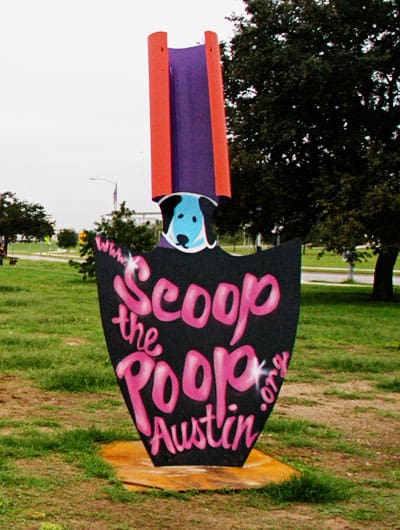

Austin's Scoop the Poop campaign in Zilker

Around dusk on Sunday, the park begins to clear of its visitors. In the blazing sunset, families pack up their cars, joggers down a last cup of water, and kayaks and swimmers retreat from the water. As the people of Austin leave, the grounds of Zilker Park truly illustrate their beauty. The park seems to visibly settle down from the day’s activity and return to a state of natural beauty and rest. The sunshine reflects on the water, and I am reminded of what a gift this park truly is. Every day, the city of Austin has the privilege of enjoying a natural place in many different ways, and the park is better because of it. The people who have been profoundly affected by this space have bettered it, with the creation of the playground, maintenance of the Town Lake Trail, and the countless people who have donated their time to keeping the park available to the entire community. Jacobs may have said that a street culture is the best way for a city to thrive, but looking at the grounds of the park and being immersed in the beauty of the diverse space, I have to disagree: I can think of no better way for a city to thrive than in the sunshine of the versatile and breathtaking Zilker Park. 


Tuesday, November 8, 2011

One Great City


The musical group, the Weakerthens, began playing together during 1997 in Winnipeg, Canada. The members of their band are John Samson (lyricist, guitar, and lead vocals), Stephen Carroll (guitar and backing vocals), John Sutton (bass, backing vocals), and Jason Tait (drums). Their music is a reflection of where they are from and John Samson’s lyrics focus on issues of hope, isolation, and survival within a society riddled with injustice and a culture commodified in every possible way.Their song “One Great City” is about their hometown, which happens to be Winnipeg where they formed

.

The song is told from different angles beginning with the underground of the city working its way up until it reaches the highest point. The song lyrics and its title are contradicting because the words of the song paint the city to be repetitive and something far from great. It begins with the day ending, and the night shadows covering the city with a “darker gray”. The song describes a lot of the cities features and personality through its lyrics.

The first verse of the song introduces the city starting from the below the ground. It sings, “a thousand sharpened elbows in the underground,” and this refers to the underground mall which is called Winnipeg Square. It is nicknamed the underground and is located underneath Winnipeg’s downtown and major office buildings. Its location makes the vast majority of people who go to the mall there mostly business people and the description of “a thousand sharpened elbows” refers directly to the business people. The following line of “that hollow hurried sound of feet on polished floor,” adds to the description of the high end working class who move swiftly and the fact that the floor is polished lets us know that the mall is well kept because it is meant for the wealthy. The next line takes the angle of the city to above the ground and says, “In the dollar store the clerk is closing up and counting loonies, trying not to say I hate Winnipeg.” This line is meant to show how the other half of Winnipeg lives aside from the wealthy. The dollar store clerk works to provide for himself, while the high end probably shops at the underground mall. The idea of the store clerk counting loonies hints that there are probably people in a worse living state then the clerk which would make it understandable for the clerk to say I hate Winnipeg.

The song then switches the perspective to a normal person on the street.

the driver checks the mirror seven minutes late
crowded riders' restlessness enunciates
the guess who suck, the jets were lousy anyway
the same mood every day
and in the turning lane
someone's stalled again
he's talking to himself
and hears the price of gas repeat his phrase
I hate Winnipeg

This verse then goes to talk about life in general in Winnipeg. How it can be repetitive and the most interesting thing in someone’s day would be being late to where they have to go in their schedule. Everyone has the same attitude everyday and their mentality towards things in their life never change because they rarely experience something new or better. The lines, “and in the turning lane, someone’s stalled again,” may refer to how a person has a chance to change his life or the direction they are headed, but is stuck and just can’t escape the city. The ending line of this verse that says, “And hears the price of gas repeat his phrase, I hate Winnipeg,” just implies one of the few problems of society.

up above us all,
leaning into sky
our golden business boy
will watch the north end die
and sing 'i love this town'
then let his arching wrecking ball proclaim:
"I...hate...Winnipeg"


This last verse talks about the golden boy which is located on top of the legislature and was the highest point in Winnipeg. He faces north because that was where the founders of the city believed the future of Winnipeg was held. The ironic part of this is that the North End of Winnipeg is the rough end of the city. The Statue which was suppose to symbolize hope,
business, and a promising future, points to the dying north end which is referred to in the song. Like in the song, he is meant to sing “I love this town” ,but rather he truly represents the rest of the town in symbolizing the corruption that occurred in Winnipeg.

The title of One Great City may not seem to mesh with the lyrics, but the role of this song I believe is to have people reflect on their hometowns as well. Every town is like someone’s Winnipeg. After living in a place for so long, things get old, people begin to notice the flaws in the city, and when people try to leave they always manage to return. The city is a part of them as much as they are part of the city. There is a hidden love for their hometown under all the negatives. It is where a person is from making a town like Winnipeg One Great City.

Sunday, November 6, 2011

City Flash Mob

City Flash Mob

    
   A flash mob is a group of people who assemble suddenly in a public place, perform an unusual and sometimes seemingly pointless act for a brief time, then disperse, often for the purposes of entertainment, satire, respect or artistic expression. Flash mobs are often organized via telecommunications. social media or viral emails.
   The term flash mob, first coined in May 2003 in Manhattan, has became one of the defining terms for a urban, liberal and richly cultural city. Most of the major cities in the world, for example, New York City, Shanghai, Sydney, Paris, etc,  have had flash mobs in the urban center. Surprisingly, even Austin has its own flash mob organization, see here.


  Flash mob shows how closely related the city is. With the aid of current technology, almost everybody can participate in a flash mob despite his color, race, language or culture. Words spread via social networking sites like Facebook or blogs, as well as by word of mouth, text or email. Various groups of people converge together and function as a whole. Flash mob reveals a city's unity at its best.


These are the cities where the most famous flash mobs happened.

                                                    NYC
                                                                     Paris
                                                             Shanghai
                                                                Sydney

Thursday, October 27, 2011

"Lush Life"


 "Lush Life" - Hartman and Coltrane


I used to visit all the very gay places
Those come-what-may places
Where one relaxes on the axis of the wheel of life
To get the feel of life from jazz and cocktails

The girls I knew had sad and sullen gray faces
With distingue traces that used to be there
You could see where they'd been washed away
By too many through the day, twelve o'clock tales

Then you came along with your siren song
To tempt me to madness
I thought for awhile that your poignant smile
Was tinged with the sadness of a great love for me
Ah yes, I was wrong
Again, I was wrong

Life is lonely again and only last year
Everything seemed so sure
Now life is awful again
A trough full of hearts could only be a bore

A week in Paris could ease the bite of it
All I care is to smile in spite of it

I'll forget you, I will while yet you are still
Burning inside my brain romance is mush
Stifling those who strive

So I'll live a lush life in some small dive
And there I'll be
While I rot with the rest of those
Whose lives are lonely too


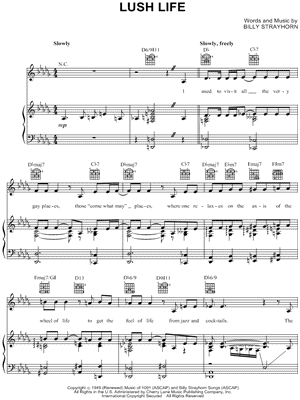
     The song "Lush Life" is a jazz standard written by Billy Strayhorn in 1933-38. Along with "Take the "A" Train," "Lush Life" is one of Strayhorn's signature compositions, having been covered by many widely known musicians such as Nat King Cole, Ella Fitzgerald, John Coltrane, and Queen Latifah. The song has a low tempo, but is full of complex chord changes that result in a dreary, and almost dissonant sound at times. Listening to this song reminds me of Toni Morrison's novel Jazz because the frequent chord and key changes which constantly change the mood of the song  echo the sporadic mood and perspective changing of the narrator in Morrison's novel. The lyrics of the song also parallel different themes, places and even characters from Jazz. The "come-what-may places" that Strayhorn refers to are the jazz clubs that were prevalent throughout the early 20th century. These are the very same jazz clubs that Dorcas was drawn to in her time with the Miller Sisters. Another theme the song and book have in common is the theme of loneliness and getting left by someone. Strayhorn states that he was wrong about the "smile tinged with great sadness of a great love," which parallels the dynamic between Dorcas and Joe. After Dorcas stopped seeing Joe, Joe could not stop thinking about her, much like how in the song, Strayhorn states that "Burning inside [his] brain romance is mush." The "Lush Life" that Strayhorn refers to in the final stanza of the song is a life of going to "dives," or jazz clubs. The significance in the title "Lush Life" for the novel written by Richard Price is that in the book, the lower east side is an incredibly dense and diverse area, and although the word lush literally means dense with vegetation, the lower east side is lush with an array of different backrounds, histories, and cultures. 

      
Queen Latifah's rendition of "Lush Life"

Jamaican Me Crazy


When people think of visiting Jamaica, they imagine a tropical paradise of beautiful beaches and green mountains where people do nothing but dance and listen to reggae music. And this is the Jamaica most tourists will see.

But my freshman year at St. Stephen’s, I got the opportunity to see Jamaica as it really is with the soccer academy. The beaches and mountains are not as picture perfect as the brochures suggest, and life is sometimes hard for Jamaicans. Still there’s a lot of beauty and joy to be found even in the hidden Jamaica I saw.


When we first arrived in Montego Bay, on the northwest coast of the island, we did experience something of the stereotypical Jamaica. The song “Welcome to Jamrock” was playing loudly over the speakers outside of the airport, and the smell of ganja was thick in the air. On the two and a half hour bus ride to go sixty miles across the island to Kingston, the stereotype was quickly replaced by less familiar impressions of Jamaica. First the drive itself was pretty scary because the roads over those picturesque green mountains were narrow and steep.

Second, the city of Kingston was much poorer and more rundown than you might see in the beach side resorts. Even the nicer areas of town would lack what any of us would consider to be basic features such as clothes dryers. The prep school where a former St. Stephen’s boarding student went looks no nicer than the oldest and most neglected schools in our city, quite a contrast to St. Stephen’s. Without the school’s name on the side, one might easily mistake it for a prison.


Life is also not a nonstop party. On our trip we visited an orphanage, not a place most tourists would visit. Still, despite the poverty, the Jamaicans we met were almost universally happy and friendly. The orphans greeted us with smiles, merchants along the road were happy to introduce us to local snacks, and life in many ways seemed very similar to life here in the states. The cities in Jamaica that I saw were rougher and dirtier than I was expecting but were also warm and welcoming.

Wednesday, October 19, 2011

The Natural City


 We've been waiting all our lives
for things we've always had but have no eyes to see.
Something new is going to happen,
The most natural thing but nothin' we'd expect.

All these buildings and mountains
slowly they'll arise
before our eyes.

How do cities understand?
We drink our wine and wonder why we're really here
What's the point of even asking?
You take the good and bad and make the best of it.

All these buildings and mountains
slowly they'll arise
before our eyes.

All these buildings and mountains
slowly they'll arise
before our eyes.

have you watched the cities move
does nature fall before this age of industry
for today I'll let it go
you've been good to me have I been good to you?

All these buildings and mountains
slowly they'll arise
before our eyes

All these buildings and mountains
slowly they'll arise
before our eyes


The song "Buildings and Mountains", by the Republic Tigers may seem like meaningless existentialism to some, but I want to explore an idea that they bring up: Is there a connection between the city and nature? In a black & white world, the answer is no, but when looking at the grey area they are in many ways connected in how they are defined. Just looking at the lyrics, in the chorus, they say that both buildings and mountains will arise; in the same way that nature grows and changes, sometimes shaped by humans, the cities develop in the same way. They ask "how do cities understand?" as though there is some connection between the city and its inhabitants, as though the city is made to be perfect and these flawed creatures live within it. It talks about cities moving and nature falling before it, but not in the form of a statement, but in a question. This brings up the question of is nature strong enough to resist the growth of this mechanized city, or does the city replace it all together. The Republic Tigers might be right that the city itself could be "the most natural thing, but nothin' we'd expect".


In many ways, the city does replace Nature. A passage in the nior novel, The Big Sleep, by Raymond Chandler, really brought my attention to this idea. The passage reads:


"It's beautiful." I pulled up beside a loading platform. We got out. I listened. The hum of traffic was a distant web of sound, like the buzzing of bees. The place was as lonely as a churchyard. Even after the rain, the tall eucalyptus trees still looked dusty. They always look dusty. A branch broken off by the wind had fallen over the edge of the sump and the flat leathery leaves dangled in the water.

Looking at this scene, it seems very desolate and that nature has been destroyed by the city that developed in novel, but I view it as more of a new kind of nature, what the Republic Tigers would say is the most natural thing, but nothing you would expect. The layer of dust that coats the trees acts like a haze that is spurs the evolution of the trees to last in the city, as though the layer of dust protects them from being destroyed by the city, but changes them so that they are now something less than a tree, and the leaves from it are now leathery as a means of adapting to the city. The bees that would be found in nature, carrying pollen for plants to grow and reproduce, are replaced by cars that carry cargo or people that allows for cities to grow and reproduce. The empty spaces that formerly belonged to nature are even now used for churches and people. The stereotypical view of the city is that it destroys nature to make room for the city, but this passage almost shows how the city doesn't destroy nature, but instead forces it to change with the city in order to survive. 

In more modern times, there have been efforts made in society to try and restore nature to its former glory before the city, within the city. This notion of making a city "green" simply by making it more energy efficient and using new forms of energy. The currently accepted "bad" non-sustainable energy sources are plants that use coal, nuclear, gas, or similar fuel sources; what is know as "good" sustainable energy sources are solar panels, wind turbines, or dams. So what society considers to be "green" energy sources are the sun, wind, and water. Ask any biologist what plants need to grow and survive and he'll most likely tell you, the sun, air, and water. So are these new buildings that claim to be "green" so far from plants themselves? If you think about the economic advantages of using sustainable energy sources, inside such large (non-residential) buildings, businesses develop and grow inside them, and not having to pay as much for energy over the long run can lead for more growth, maybe creating branches, spreading out. Just the phrase green energy makes people think of a city that can get all its energy through the same methods that energy is made in nature to in some ways make the city more like nature. City and nature are two contrasting things that are becoming more alike as they both try to grow and thus have to grow into the other.

Sunday, October 9, 2011

Whole Foods vs. Austin Liberalism


Skyline on the roof of Whole Food
By Luke Zhang
               The flagship store of Whole Foods on 525 North Lamar Boulevard might probably be considered as a symbol of Austin Liberalism. Surrounded by apartments, office compounds and hotels, Whole Food is artificially designed as a natural and welcoming compound for everybody. Its scenery makes sure that the grocery store not only offers organic products, but also attracts local residents to spend their leisure time there. Whole Foods therefore becomes a mixture of commerce and living. Theatrically intended as a family friendly gathering place where everything is harmonious and laid back, Whole Food seems to fit in with the liberal aspect of Austin. Yet, as we dig deeper in our observation, we find its style contradict against the liberal soul of Austin. After all, we conclude that Whole Foods is just a grocery store trying to sell its upscale organic products to a limited variety of people.

Infant Seat
By Luke Zhang
                In order to appear as liberal as possible, the Whole Foods in Austin’s downtown area tries to impress people by advocating natural environment and free soul around the store, thus instilling a sentiment to its customers that they can do whatever they wish here. Picnic tables can be found all over Whole Foods --- located right next to the cashiers, up on the second floor, outside of the store, and even on the roof. To accompany the tables, shades are built to mimic trees and natural scene such as artificial rocks and fine-looking flowers. To further promote greenness, smoking-free signs can be seen anywhere in the park, trash is categorized into as many as six cans. The place is not merely green, but also convenient for people to spend some quality family time, as it is both animal and baby friendly. As we observe the store in the park, we see more than five pets sitting next to their owners and enjoying the afternoon sunshine, while babies are comfortably napping in the infant seats that Whole Foods provide. Even better, Whole Foods plays music from its own radio and provides free public Wi-Fi to its customers, attracting many to spend their leisure time here to do some work. From first look, all these features would make people feel like Whole Foods is a liberal place where everybody is warmly invited.
Tree-Like Shade
By Luke Zhang
                Yet, as we scrutinize this grocery store more closely, we begin to realize that the core value of Whole Foods is not too close to the idea of liberalism and even a little fascist. Even though the corporation tries hard to make it look like a welcoming place for everybody, it does tend to keep the poorer families out of its store. The hit brand of Whole Foods, “365 Everyday Value,” promises to produce the most organic food one can find in a grocery store, giving customers the sense that by purchasing them, they are eating the healthiest foods. Yet, what many people neglect is that organic does not necessarily mean healthy. For example, the “365 Slightly Salted Baked Potato Chips” has been criticized by a reviewer online as “extremely sugary,” and he suggests that instead of labeling those chips as “slightly salted,” they should be placed at the cookie aisle and be called “heavily sugared.” The “365 Everyday Value” is also more expensive than other ordinary products’. For example, as we go through the snacks section, we discover that the chips here are often as much as two dollars more expensive than the common chips brands such as Lays, which can be found in other markets such as Wal-Mart and HEB but are apparently ignored by Whole Foods. As a result, customers often find that they only have one choice when buying products in the store, the pricy “365 Everyday Value” brand. This policy shuts the door for most of the lower class families as they simply can’t afford to shop at Whole Foods, which by the way, sells the largest mark-up per product in grocery business.

Seat in Shop
By Luke Zhang
                Austin downtown’s Whole Foods not only lacks liberalism in terms of its narrow choices of products, but also influences the dynamics of its surroundings. According to our research online, when Whole Foods enters the scene in populated area such as the downtown of Austin, it severely affects the neighborhood. Usual consequences include an increase in the price of nearby hotels and apartments and the closure of smaller but cheaper convenient stores. Richer people might appreciate the existence of an organic store, but poorer citizens would not feel lucky and might even have to move out of the area since now the living cost here has dramatically increased. Whole Foods Corporation’s inconsistency with Austin’s Liberalism is not only reflected by its “unfriendliness” towards the lower income people, but also proven by its lack of diversity in terms of ethnicity. While we are spending our Sunday afternoon at the picnic table, there is only one African American walking into the store and two Asian boys doing their English project. Other than those three, all of the other people are Whites. In our opinion, Whole Food’s overly natural campaign, including the usage of brown bags, donation to plant trees, biodegradable packaging, and the advertisement of a green product line, has made the White urban customers feel like that they are embracing and saving the nature by simply consuming at the store. More significantly, the corporation successfully made customers feel good about themselves for buying healthy yet expensive products. True Austin Liberalism is not a concept for people to feel good about themselves, just like Richard Wright’s Native Son is not written to make rich white girls feel bad about African Americans.
     
Live Music Line-Up
By Luke Zhang
           To some people, Austin’s Liberalism simply means “a place where groups of hippies gather at a music hall to enjoy live music and have a sip of beer.” As we quietly listen to Adele and Stevie Wonder singing on the Whole Food radio and observe this organic store’s culture, we notice a chalk board listing all the artists who are coming to the store soon to sing. We are deeply impressed by Whole Food’s effort to make it appear as liberal as possible. Yet, at the end of the day, we still conclude that Whole Food, with its limited types of customers and selected brands of products, does not quite fit with the Liberalism of Austin.


Wednesday, October 5, 2011

Compton's Influence in Music

2010_02_<span class=
(Caution: Profanity flows freely due to the subject matter discussed in this post)

As rap music was growing on the east coast in major cities like New York, it hadn't quite spread to the west coast. However, eventually, rap spread to the west coast. Compton, California is located just south of Los Angeles. Compton was infamous for its gang related crime including shoot outs, murders, and narcotics. The city of Compton became a major influence of Gangstar Rap(aka Gangsta Rap) in the shaping of rap history. Gangsta rappers rapped about their experiences in Compton, selling drugs and running with the gangs (the Bloods and the Crips). By the 90's, Compton was recognized as the center of West Coast and Gangster Rap, producing rappers like Ice-Cube, Dr. Dre, Easy E, Tupac and Snoop Dog. Many new record companies also sprouted up in Compton. Including Total Trak Productions (TTP), named after the gang Tree Top Pirus located in Compton and Death Row Records run by Marion Suge Knight, a well known gang leader. Easy E also started a record label in Compton which he claimed was funded by his selling of cocaine and other narcotics in Compton.

Map of Compton, CA

N.W.A was one of the most famous rap groups that originated from Compton. In fact, N.W.A pioneered Gangsta Rap on the West Coast. N.W.A rapped about their tough upbringing in Compton. In their album Straight Outta Compton, N.W.A wrote some very controversial songs such as "Fuck tha Police."
N.W.A said that they rapped about reality. In song "Fuck tha Police," N.W.A treats the song as if it is court hearing in which different artists from the group "testify" against police brutality and racial prejudices. For instance, when Ice-Cube raps "Fuck the police/Comin straight from the underground./Young nigga got it bad cuz I'm brown/And not the other color so the police think/They have the authority to kill a minority...With a little bit of gold and a pager/Searching my car, looking for the product/Thinking every nigga is selling narcotics" Here, Ice-Cube questions the ethics of the police force in Compton and the prejudices that they might have towards black men as all being criminals. Since he has "gold and a pager" the police automatically believe that he is selling drugs, they don't believe that he can make an honest living. The police also think that they "have the authority to kill a minority." Ice-Cube argues the injustice of the society and the police force because he believes no one will question a police man if he kills a minority, but if he kills a white man or women, there would be investigations into the shooting. "Fuck tha Police" even incited action from the FBI who wrote a strongly worded letters to N.W.A and the record producer Ruthless Records about the message of the song. This only inspired N.W.A to write new lyrics, and in a the song "100 Miles and Runnin'" Dr. Dre raps "the FBI is all over my dick!"

"Fuck tha Police"

Selected Lyrics from the song "Fuck tha Police" by N.W.A

Right about now NWA court is in full effect.
Judge Dre presiding in the case of NWA versus the police department.
Prosecuting attourneys are MC Ren Ice Cube and Eazy muthafuckin E.
Order order order. Ice Cube take the muthafuckin stand.
Do you swear to tell the truth the whole truth
and nothin but the truth so help your black ass?

Why don't you tell everybody what the fuck you gotta say?

Fuck tha police
Comin straight from the underground
Young nigga got it bad cuz I'm brown
And not the other color so police think
They have the authority to kill a minority

Fuck that shit, cuz I ain't tha one
For a punk muthafucka with a badge and a gun
To be beatin on, and throwin in jail
We could go toe to toe in the middle of a cell

Fuckin with me cuz I'm a teenager
With a little bit of gold and a pager
Searchin my car, lookin for the product
Thinkin every nigga is sellin narcotics...

M. C. Ren, will you please give your testimony to the jury about this fucked up incident.

Fuck tha police and Ren said it with authority
because the niggaz on the street is a majority.
A gang, is with whoever I'm stepping
and the motherfuckin' weapon
is kept in a stash box, for the so-called law
wishin' Ren was a nigga that they never saw

Lights start flashin behind me
But they're scared of a nigga so they mace me to blind me
But that shit don't work, I just laugh
Because it gives em a hint not to step in my path

To the police I'm sayin fuck you punk
Readin my rights and shit, it's all junk
Pullin out a silly club, so you stand
With a fake assed badge and a gun in your hand

Fuck the police (4X)

Police, open now. We have a warrant for Eazy-E's arrest.
Get down and put your hands up where I can see em.
Just shut the fuck up and get your muthafuckin ass on the floor.
[huh?]

and tell the jury how you feel abou this bullshit.

Fuck the police (4X)

The jury has found you guilty of bein a redneck,
whitebread, chickenshit muthafucka.
Wait, that's a lie. That's a goddamn lie.
I want justice! I want justice!
Fuck you, you black muthafucka!

Fuck the police (3X)

Other songs like "Gangsta Gangsta" describe their lives growing up in the city of Compton where they were surrounded by crime and violence. "Straight Outta Compton" was another song in which N.W.A rapped about the reality of the street life. When Dr. Dre says, "You are now about to Witness the strength of street knowledge" he is telling the audience that N.W.A has experienced the harsh life on the streets in the inner cities and these are some of the lessons that they learned while growing up in Compton. Later, when MC Ren raps, "Straight Outta Compton, Another crazy ass nigga/ More punks I smoke, Yo, my rep gets bigger." Here, MC Ren illustrates one of the important lessons of the inner city streets, the importance of a street "rep" (reputation). A strong street "rep" in important to surviving in the inner cities. In order to build a "rep" one must become known for his ability to inflict violence. The "more punks" someone "smokes" or shoots, the more one is feared and respected because of his or her reputation of being a killer.

"Straight Outta Compton"

Selected Lyrics from the song "Straight Outta Compton" by N.W.A

You Are Now About To Witness The Strength Of Street Knowledge

Verse One: Ice Cube

Straight Outta Compton, Crazy Motherfucker Named Ice Cube
From The Gang Called Niggaz With Attitudes...

Goin Off On A Motherfucker Like That
With A Gat That's Pointed At Yo Ass...

Here's A Murder Rap To Keep Yo Dancin
With A Crime Record Like Charles Manson
AK-47 Is The Tool


So When I'm In Your Neighborhood, You Better Duck
Coz Ice Cube Is Crazy As Fuck
As I Leave, Believe I'm Stompin
But When I Come Back, Boy, I'm Comin Straight Outta Compton

Chorus:

[City Of Compton, City Of Compton]

[Eazy E] Yo Ren
[MC Ren] Whassup?
[Eazy E] Tell Em Where You From!

Verse Two: MC Ren

Straight Outta Compton, Another Crazy Ass Nigga
More Punks I Smoke, Yo, My Rep Gets Bigger
I'm A Bad Motherfucker And You Know This...

Shoot A Motherfucker In A Minute...

A Crazy Muthafucker From Tha Street
Attitude Legit Cause I'm Tearin Up Shit...

See, Coz I'm The Motherfuckin Villain...

But A Nigga Like Ren Is On A Gangsta Tip
Straight Outta Compton...

Chorus:

[City Of Compton, City Of Compton]

[Damn That Shit Was Dope!]

Straight Outta Compton reached number 37 on the U.S billboards, selling over 3 million copies and receiving a double Platinum award, and was named the 62 best album of all time by Rolling Stone Magazine.

Album Cover of Straight Outta Compton

As a result of the rise of West Coast Rap, a feud between the West Coast and the East Coast was sparked. The most powerful record labels in this feud was Death Row Records from Compton, and Bad Boy Records from NYC which featured rappers like Notorious B.I.G.
After an awards show in which members from the west coast rappers and east coast rappers attended, there was a party at the El Rey theater were one was killed. One of the most infamous crimes related to West and East Coast feud was Tupac's murder. When Suge Knight of Death Row Records, and Tupac beat up Orlando Anderson in a gang related incident, Anderson shot Knight and shot and killed Tupac. After months of investigation, Knight was prosecuted for his involvement in Tupac's death as well as many gang related crimes like the selling of narcotics.
The West Coast felt that Bad Boy Records from the East had hired Anderson from the South Side Crips in Compton to kill Tupac, and therefore, they retaliated. After the 11th annual Soul Train Awards in L.A. Notorious B.I.G was shot and later died. The West Coast and East Coast feud had left its mark, with the murders of two of the greatest rappers of their time: Tupac and Notorious B.I.G.

Saturday, October 1, 2011

Location-Aware Album by Bluebrain

The National Mall by BLUEBRAIN. The First Location-Aware Album from BLUEBRAIN on Vimeo.

This is a trailer for the "location aware" album by Bluebrain, The National Mall, based on Washington, D.C. As the Pitchfork article that brought my attention to it describes, it's like bringing the soundscape of a video game to real-life. The project appeals to me because I am from Washington, D.C. and have walked around the National Mall to my own mixtape many times. In general, though, I like to coordinate my listening to place, thinking about good road trip mixes for different destinations and the best arrival music to various locations (thanks to the Jim Jarmusch film, Down By Law, New Orleans will always be Tom Wait's Rain Dogs for me).

Here is how Ryan Holladay of Bluebrain describes the project:

We thought, “What if you replace that map within the videogame terrain with the coordinates of an actual map?” In this case, the National Mall. And instead of assigning sounds, like you would in a videogame, to mimic real life, what if you made it musical, or surreal? For instance, as you start at the base of that hill [at the Washington Monument] you hear a single cello and piano. And as you make your way up to the top, more and more instruments keep getting added, to the point where you’re literally at the very top, touching the Monument, and you’re hearing out-of-control blast beats.

Though I have not downloaded the iPhone app and taken the music tour created by the band, one thing I notice and like about the trailer above is that the sense of place is not simply monumental, visiting the major landmarks in the most straight-forward way possible as a tourist would. The approach seems glancing, as with the avatar's experience at the Washington Monument and Lincoln Memorial. Sharing this quirky perspective on place seems like a major contribution to the democratic mapping of Washington, D.C. In a sense, it nurtures the kind of perspective Noah gives us in his post, "The Capitol Who Watches Over All," which opposes the singular conception of the city from the pov of the Capitol.

(All images are screen captures from "The National Mall" video trailer by Bluebrain.)