Showing posts with label multiplicities. Show all posts

Wednesday, November 2, 2011

The Suburbs


The TV show Weeds, created Jenji Kohan, critiques and compares inner city and suburban life in America. Nancy Botwin (Mary-Louise Parker) plays a white, middle aged, widowed mother who begins to sell marijuana in order to maintain her wealthy suburban lifestyle after the death of her husband. Nancy lives in a wealthy suburb called Agrestic in California. Agrestic is a symbol of a perfect, wealthy, white, American suburb. In every episode, Kohan critiques this "perfect" white suburban lifestyle with the theme song "Little Boxes" written by Malvina Reynolds.


"Little Boxes"
Little boxes on the hillside,
Little boxes made of ticky tacky,1
Little boxes on the hillside,
Little boxes all the same.
There's a green one and a pink one
And a blue one and a yellow one,
And they're all made out of ticky tacky
And they all look just the same.

And the people in the houses
All went to the university,
Where they were put in boxes
And they came out all the same,
And there's doctors and lawyers,
And business executives,
And they're all made out of ticky tacky
And they all look just the same.

And they all play on the golf course
And drink their martinis dry,
And they all have pretty children
And the children go to school,
And the children go to summer camp
And then to the university,
Where they are put in boxes
And they come out all the same.

And the boys go into business
And marry and raise a family
In boxes made of ticky tacky
they look just the same.
There's a green one and a pink one
And a blue one and a yellow one,
And they're all made out of ticky tacky
And they all look just the same.


"Little Boxes" portraits white suburban life as dull. Everyone goes to the same university, everyone gets the same job and goes to the same coffee shop before work. Reynolds argues that this wealthy white American dream causes people to conform to what society believes is the correct way to live and raise a family. However, it really just makes everyone into the same boring person.
Nancy breaks the mold. Although, she still wants to enjoy her life in suburbia. She doesn't have a really job or money to support her family, so she resorts to selling weed. This brings up an interesting contrast. For many wealthy white families, the attraction of the suburbs is to avoid the violence, drugs, and conflict of the inner city. However when Nancy decides to start selling weed, she brings these inner city problems to Agrestic. For instance, at the end of season 3, Nancy buys protection from Guillermo, another drug dealer from the city. As a result, Guillermo begins a "war" between rival drug dealers to protect Nancy's business in Agrestic. However, when Guillermo burns down a local weed farm, it causes Agrestic to catch fire and burn to the ground.
Weeds also illustrates the racial tension between white suburbians and Nancy's black drug dealing partners. In an episode in Season 3, Nancy buys a grow house in Agrestic, and her black friend and partner Conrad moves in. When Conrad's sister and mother go on a walk in the neighborhood, they meet a jogger, who waves and smiles, then runs to the other side of the street to continue jogging. This jogger shows the tension between races that can still make some people uncomfortable. Suburbia has high taxes and is for high income families. As a result, wealthy white families are usually the ones who move to the suburbs. So when this jogger sees Conrad's black mother and sister, she becomes uncomfortable because they just seem out of place.

Tuesday, October 4, 2011

The Laramie Project

The Laramie Project was written by Moises Kaufman and the members of Tectonic Theatre Project as an investigation of a brutal hate crime in the town of Laramie, Wyoming. This play is taken entirely from interviews of Laramie residents, and the journal entries of the Tectonic Theatre Project, and in this way, it gives a completely genuine and fascinating look at Laramie from the inside and from the outside. The way Tectonic views Laramie changes a lot throughout the course of the play. Beginning with the view of Laramie as your typical town, it morphs to become something just a little out of the ordinary. One of the first things Greg Pierotti notices about Laramie is the welcome sign. It reads: "WYOMING -- LIKE NO PLACE ON EARTH. Instead of WYOMING -- LIKE NO PLACE ELSE ON EARTH," (27). Similarly, Barbara Pitts notices that "in the dark, [they] could be on on any main drag in America -- fast food chains, gas stations. But as [they] drove into the downtown area by the railroad tracks, the buildings still looked like a turn-of-the-century Western town," (28). Greg even swears he "saw a heard of Buffalo," (27). To the Tectonic Theatre Project, Laramie is a tiny rural town that's just a bit off. This view is also shared by Stephen Mead Johnson, a representative of the Unitarian Church who first finds Laramie to consist only of a "tumbleweed" and a "cement factory," (36).

The next scene is an interview with Marge Murray and Allison Marge who really begin to show the depth that Laramie seems to hide. Marge, in particular goes from asking "Well, yeah, honey, why wear clothes," to describing the intricacies of Laramie's view on homophobia (28). Allison and Marge are such a fantastic example of how this play operates -- one second Allison is embarrassed to explain to Greg that "S. O. L." stands for "shit outta luck," and the next Marge quite eloquently sums up Laramie's class problems with the few sentences: "It's about the well educated and the ones that are not. And the educated don't understand why the ones that are not don't get educated," (29). Though both Marge and Allison seem like your typical comical country bumpkins, they both have a lot more to say about Laramie, Wyoming than anyone would expect. Marge ends this scene by frankly telling Greg that she's know more than she's telling him.

At the end of the play, Tectonic leaves the "sparkling lights of Laramie, Wyoming," with a completely different perspective on this tiny town (88).

Kaufman, Moises, and Leigh Fondakowski. The Laramie Project. New York: Dramatists Play Service, 2001. Print.

Wednesday, August 31, 2011

Shanghai, shanghai


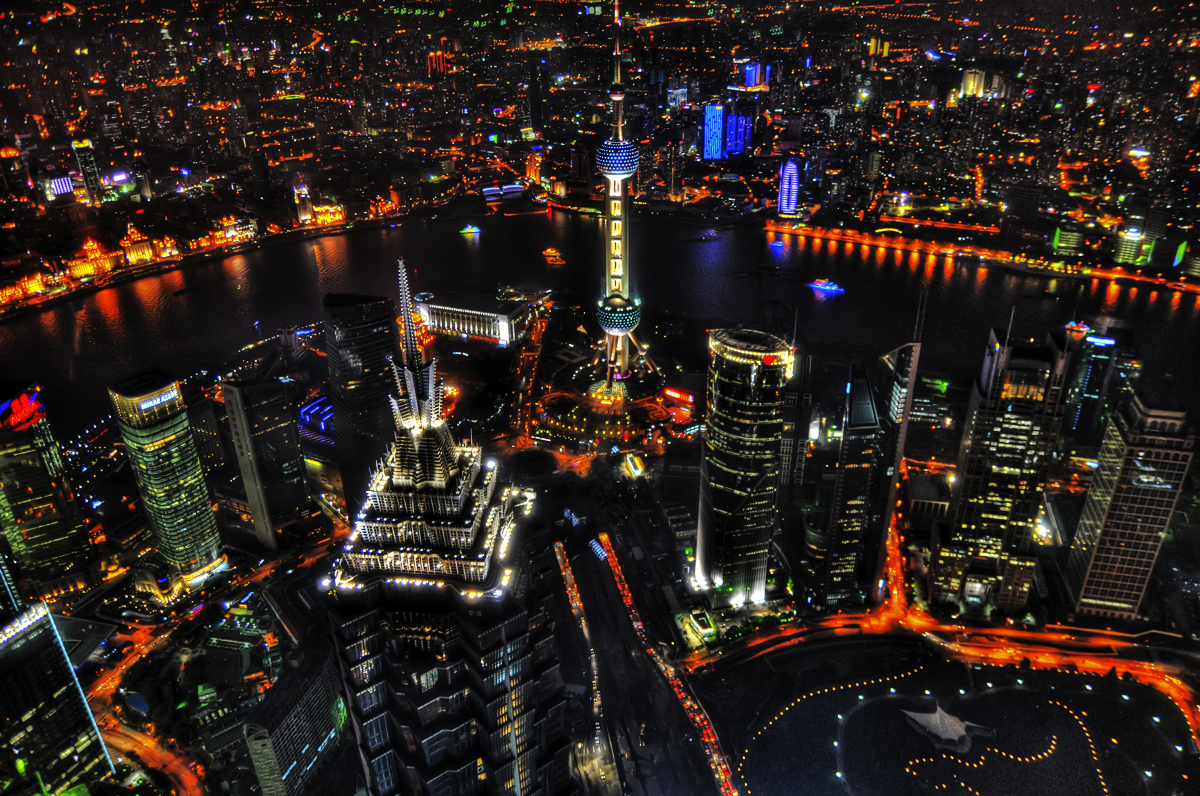
Shanghai is one of the largest cities by population in the world. During the last decade of the booming of Chinese economy, it has flourished to a global city, exerting influence over finance, commerce, fashion, technology and culture.


Today, Shanghai is the leading financial center in Asian continent; it's own stock market Shanghai Stock Exchange ranked their among worldwide stock exchanges in terms of trading volume; it has over 20 million residents; it just held the World Exposition in 2010; it has over 13 metro transportation lines; ATP World Tour took place in Shanghai; F1 took place in Shanghai; Transformer 2 was shot in Shanghai......


However, under the shade of prosperity, Shanghai is a vicious magnet, attracting migrant laborers to come and contribute their life to the venal magnates. Let's look at some facts and statistics. Shanghai has a bigger population than Australia's. Out of the 23 million people in the city, 9 million of them are migrants from all over the country. Then, out of the rest of 14 million residents, only 35% of them are natural Shanghaiese, born in Shanghai and speak Shanghaiese, a local dialect only spoken in Shanghai, distinct to Mandarin Chinese. Similar to the immigrants culture in New York City, a foreign is formed by various groups of emigrants in Shanghai.


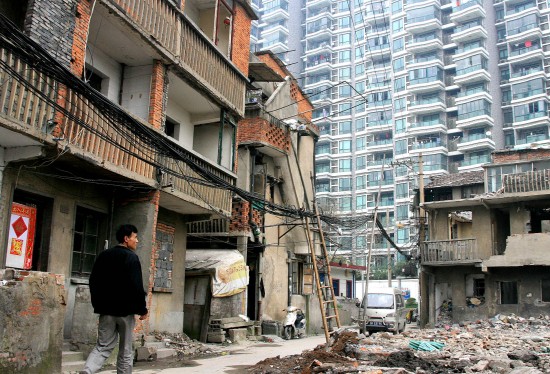
This is a typical tenement, maybe even a fancy one since it has only one storey and a yard. Behind the tenement we can see that there is a silver modern building. In all the images one can find online, Shanghai is composed by a medley of uneven fashionable buildings, but here in this picture there is only one. On the second door from the right, a red Chinese letter is written on it: "拆“, which means demolishing. The tenement we are looking at here is about to be pulled down, or already pulled down by now. Because another groups of modern building is about to be constructed here. It means that the migrant workers living in the tenement are forced to leave and find somewhere else to squeeze in.


shanghai
v. to put by trickery into an undesirable position


Other than the "Shanghai" you can find here, (just kidding, here). There exists the invisible "shanghai" behind it. It locates at every blind spot away from the city's resplendence. Shanghai, lures these migrant workers with its exhaustible opportunities and limitless wealth, cram them into slums and extort cheap labor from them. No "rags to riches" story could possibly blossom there because "infants" are already smothered in the "nursery". While the urban city expands, these "ugly" tenements are torn down and workers are driven out from their home. The city's improvement is based on the sacrifice of diligent, innocent workers. Once a worker offered all his labor to the city, the city repels him, leaving him no opportunity nor even a shack for him to live. Behind the glory and splendor, the human nature of greed and hideousness forms the invisible city - shanghai.


After all, where can he go?