"Long after our cities are condemned and destroyed, our parks will stand as a testament of the serenity of our weekends to distant trespassers."
-Benson Bruno
In the 1960s, Jane Jacobs, an activist interested in urban communities, theorized that parks, contrary to most municipal politicians’ beliefs, are not beneficial to a city. Jacobs wrote that parks are not useful because they do not offer a city center for diverse events and people to come together and bond the city. Jacobs, however, never came to Austin, and never saw Zilker Park, a hub of culture that gives Austin a unique flavor and soul.
Jacobs believes that streets are beneficial to cities because they house businesses and therefore communities. However, Zilker Park is home to many small local businesses. Near Barton Springs, there is a small kayak and canoe rental place. I asked the people working there a couple of questions about the park and their work. The business had been in operation for a long time, which is a testament to Zilker's year-round popularity. The workers also had positive things to say about the variety they see in their customers.

| The boats of Zilker Park Kayak Rentals. Source: http://www.freeaustinfun.com |
Zilker is indeed a diverse community. Located in the heart of the city, Zilker attracts people of all kinds. On one given Sunday, many different people were out enjoying the natural beauty the park offers. A Hispanic family celebrates a birthday at one of the picnic tables, two Chinese students from UT talk as they walk the Town Lake trail, and an elderly white couple orders food from a snack stand. Zilker’s diverse visitors prove Jacobs wrong yet again. Neighborhoods tend to house only one demographic, while Zilker has served Austinites of many varieties since it opened in the 1930s.
 Diverse group of college kids enjoy a picnic in Zilker Source: http://thesiftedlife.files.wordpress.com |
Zilker is valuable to Austin because it offers so many different activities for the Austin community. City wide events like the Kite Festival are held there, along with smaller events like soccer games and beach volleyball tournaments. Austin was named one of the top ten fittest cities in America, and Zilker Park helped create that image. Zilker Park is home to the famous Town Lake Trail, which attracts about 1.5 million visitors a year. Every day, people in the Austin community run and bike the ten mile loop. Big fitness events like the Livestrong Bike Challenge are hosted by Zilker, and the sounds of people finishing the strenuous race for the cure could be heard all over the park.
Another feature of the park is Barton Springs. Barton Springs is a natural spring, and people have been swimming there since the 1940s. Though the springs average a chilly 68 degrees Fahrenheit, the people of Austin come from far and wide to enjoy the springs. Barton Springs was segregated for a short period of time, but soon the spring was entirely open to all Austin citizens, illustrating Austin’s socially innovative history. Interestingly enough, one side of Barton Springs requires a fee to enter, and the other, less developed side is free to the public. Some regulars say that there is a new disparity now days, as teenagers and young adults congregate on the free entry side while families and older people prefer the calm of the pay to enter half of the springs. Despite this de facto separation, people of all varieties are here on this lovely fall day enjoying the chilly waters.

The event that has gained Zilker Park the most fame is the Austin City Limits Musical Festival. Each fall, Zilker hosts about 90 musical performers and roughly seventy thousand music fans from Austin and beyond. Nicknamed ACL, it captures Austin by featuring local artists and selling food exclusively from local Austin restaurants, often under the “Keep Austin Weird” moniker, In the past, the festival has been criticized for not being racially diverse in the artists included in the line up. However, in recent years, the festival has diversified and invited a wide range of artists, including Kanye West, Norah Jones, Stevie Wonder and Esperanza Spalding. With it’s widening pool of genres, ACL has also attracted a more diverse group of attendees. While the high ticket price keeps some people away, most people don’t mind paying high prices to be immersed in Austin’s lively music scene. The festival also attracts a wide age range: older music fans flock to here old favorites like the Eagles while kids younger than ten can get in free with a ticket holding adult. Thanks to this policy, the park fosters an appreciation of the unique Austin music scene in people from a young age. Environmentally, the festival has tried to minimize it’s footprint by selling shirts made from recycled materials and selling boxed water rather than bottled water. Each year, the festival changes and improves, impacting Austin in a special way. The people I interviewed at the eleventh annual festival had nothing but positive things to say about the festival.
 |
| View of Austin skyline from Zilker during ACL. Source: http://www.mymilestone.com/ |
Zilker Park’s most positive attribute is it’s availability to kids. Jacobs believes that kids benefit from a street focused community because it offers free space to grow and play. However, Zilker Park does just that, but in a natural environment. Zilker features a playground, which is free and open to all children. A small train called the Zilker Zephyr runs a small loop around the park every thirty minutes for a small price, which is often a favorite amongst the kids.
The kids benefit from this environment more than they would from a city street environment because the space is designed for children and is exclusively designated for them, keeping them safe and happy. As kids turn into kids at heart, they can use other aspects of the park for recreation. Teenagers flock to the park on sunny afternoons to play pick up soccer games, throw frisbees have picnics on the grounds. Zilker is valuable to Austin because it’s useful and accessible to Austinites of all ages.
 |
| Zilker Train. Source: http://www.livemom.com/ |
Austinites are known for their attachments to their fluffy friends, and Zilker accommodates that special relationship by designating a “leash free” space for dogs to run around, play with their masters, meet other dogs and splash around. Unlike a city street, the park provides the perfect venue for human and animal interaction, creating a space for a largely dog loving community to convene. A strict policy on poop pick up keeps the park clean, and many Austinites and their dogs happily utilize the space.
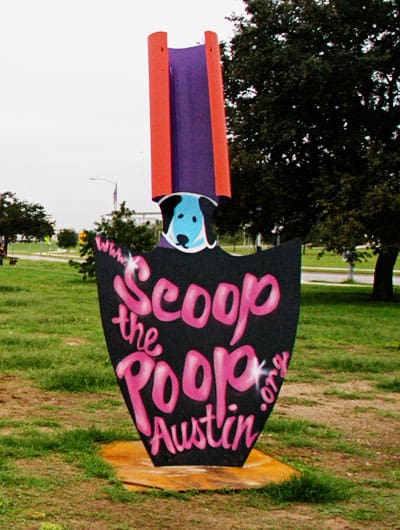 |
| Austin's Scoop the Poop campaign in Zilker |
Around dusk on Sunday, the park begins to clear of its visitors. In the blazing sunset, families pack up their cars, joggers down a last cup of water, and kayaks and swimmers retreat from the water. As the people of Austin leave, the grounds of Zilker Park truly illustrate their beauty. The park seems to visibly settle down from the day’s activity and return to a state of natural beauty and rest. The sunshine reflects on the water, and I am reminded of what a gift this park truly is. Every day, the city of Austin has the privilege of enjoying a natural place in many different ways, and the park is better because of it. The people who have been profoundly affected by this space have bettered it, with the creation of the playground, maintenance of the Town Lake Trail, and the countless people who have donated their time to keeping the park available to the entire community. Jacobs may have said that a street culture is the best way for a city to thrive, but looking at the grounds of the park and being immersed in the beauty of the diverse space, I have to disagree: I can think of no better way for a city to thrive than in the sunshine of the versatile and breathtaking Zilker Park.


