Showing posts with label smart city. Show all posts

Thursday, November 10, 2011

Efficiency and Human Nature

Efficiency as defined by Wikipedia:
Efficiency in general describes the extent to which time or effort is well used for the intended task or purpose. It is often used with the specific purpose of relaying the capability of a specific application of effort to produce a specific outcome effectively with a minimum amount or quantity of waste, expense, or unnecessary effort.
     In the late 1800's, Frederick Winslow Taylor developed methods of labor productivity, one of many types of efficiency, called Taylorism. Taylorism was largely accepted by industries seeking to increase profits and reduce waste. Despite looking good initially, this "efficiency" also met a lot of criticism. In the early 1900's the Senate in fact banned Taylor's methods when an investigation found the majority of workers to be hostile towards the amount of control the managers had over them. Similarly, in Taylorism, workers with talent and potential were treated the same as unskilled workers creating a system that catered to drones, not humans. I find this historical context helpful because it is an example of how "efficiency" does not often work well with human nature.

     In Blade Runner, Ridley Scott shows us a world full of "efficiency". Technology has advanced far enough to enable street vendors to do DNA tests on synthetically manufactured snake scales and housing shortages are clearly no longer an issue. However despite such advances there are clearly major problems still plaguing the city and in fact the majority of people have fled off-world. In the world of Blade Runner, replicants have been created for the purpose of colonizing other planets. Such a feat by genetic designers, creating robots that are superior to the creators themselves, would be looked at by our society today as amazing and extremely beneficial. However, as seen by the goal of the Blade Runners which is to "retire" the replicants, these technological advances have gotten too far out of hand and the efficient city which we had been working towards for hundreds of years is no longer efficient for humans.

Sunday, November 6, 2011

City Flash Mob

City Flash Mob

    
   A flash mob is a group of people who assemble suddenly in a public place, perform an unusual and sometimes seemingly pointless act for a brief time, then disperse, often for the purposes of entertainment, satire, respect or artistic expression. Flash mobs are often organized via telecommunications. social media or viral emails.
   The term flash mob, first coined in May 2003 in Manhattan, has became one of the defining terms for a urban, liberal and richly cultural city. Most of the major cities in the world, for example, New York City, Shanghai, Sydney, Paris, etc,  have had flash mobs in the urban center. Surprisingly, even Austin has its own flash mob organization, see here.


  Flash mob shows how closely related the city is. With the aid of current technology, almost everybody can participate in a flash mob despite his color, race, language or culture. Words spread via social networking sites like Facebook or blogs, as well as by word of mouth, text or email. Various groups of people converge together and function as a whole. Flash mob reveals a city's unity at its best.


These are the cities where the most famous flash mobs happened.

                                                    NYC
                                                                     Paris
                                                             Shanghai
                                                                Sydney

Saturday, October 15, 2011

The Imperfection of Perfection within Cities

Tron Legacy is a science fiction film directed by Joseph Kosinski. The main characters of this movie are Jeff Bridges as Kevin Flynn and Clu, and Garret Hedlund as Sam (Kevin Flynn's son). Tron is a movie about Sam's journey into a virtual reality world that his father, Kevin Flynn created, called The Grid. After the disaperance of his father, Sam became the biggest share holder of his father's company, ENCOM. However, Sam was not interested in his father's company. One day, Alan Bradley, ENCOM's executive, approached Sam about a mysterious "page" that was sent from his father's computer from an old abandoned arcade. While investigating the arcade, Sam found a secret computer room, where he accidentally sent himself into the virtual reality world created by his father: The Grid.

While watching the movie, I noticed parallels and contrast between Tron city and the city in reality.

Compared to the authorities in the real city, the authorities in Tron city were much stricter. In the beginning of the movie, before Sam teleported himself to Tron city, he violated the law several times, but got away: speeding on the highway and breaking into his father's company. However, when Sam arrived at Tron city, he was viewed as a flaw within the system and was immediately captured. Authorities in Tron city seek out all flaws and imperfections in the city, in order to make it the perfect city, as his father had programmed it to be. Flawed “programs” (humans in Tron city) were either "rectified" or forced to play a game, a battle to the death. Corruption and violation of the laws in Tron city was strictly punished or corrected immediately. In contrast, in the real city, the human system is not as effective in dealing with crimes.

In addition, both cities represent modernization. In the real city, we see modernization from the old brick building of the arcade to the tall, glistering glass skyscraper of ENCOM. In the Grid, the city of Tron is located in a middle of nowhere, surrounded by the barren, rocky terrain. The contrast between the structured and lighted city of Tron to the bare and wild terrain that surrounds the city, emphasizes how modernization of a city creates a boundary between humans and nature. The motor bikes used to travel around Tron city, could not be used in the rocky terrain. Compared to the arcade, the ENCOM building was much more sophisticated and technologically advanced. Similarly, Tron city is a technologically advanced city, but it separates itself from the natural world.Finally, this movie wrestles with the idea of the “perfect” city and the corruption of technology. Technological advances and development has always been seen as beneficial to human needs. However, in Tron Legacy, Kevin Flynn attempted to use technology to create the perfect world for humans to live in. He created Clu, and programmed him to help create the “perfect” world. However, Clu saw human qualities as an imperfection that needed to be destroyed. This shows how technology can be useful and beneficial, but we should not depend on technology to do human responsibilities.


Sunday, October 9, 2011

Whole Foods vs. Austin Liberalism


Skyline on the roof of Whole Food
By Luke Zhang
               The flagship store of Whole Foods on 525 North Lamar Boulevard might probably be considered as a symbol of Austin Liberalism. Surrounded by apartments, office compounds and hotels, Whole Food is artificially designed as a natural and welcoming compound for everybody. Its scenery makes sure that the grocery store not only offers organic products, but also attracts local residents to spend their leisure time there. Whole Foods therefore becomes a mixture of commerce and living. Theatrically intended as a family friendly gathering place where everything is harmonious and laid back, Whole Food seems to fit in with the liberal aspect of Austin. Yet, as we dig deeper in our observation, we find its style contradict against the liberal soul of Austin. After all, we conclude that Whole Foods is just a grocery store trying to sell its upscale organic products to a limited variety of people.

Infant Seat
By Luke Zhang
                In order to appear as liberal as possible, the Whole Foods in Austin’s downtown area tries to impress people by advocating natural environment and free soul around the store, thus instilling a sentiment to its customers that they can do whatever they wish here. Picnic tables can be found all over Whole Foods --- located right next to the cashiers, up on the second floor, outside of the store, and even on the roof. To accompany the tables, shades are built to mimic trees and natural scene such as artificial rocks and fine-looking flowers. To further promote greenness, smoking-free signs can be seen anywhere in the park, trash is categorized into as many as six cans. The place is not merely green, but also convenient for people to spend some quality family time, as it is both animal and baby friendly. As we observe the store in the park, we see more than five pets sitting next to their owners and enjoying the afternoon sunshine, while babies are comfortably napping in the infant seats that Whole Foods provide. Even better, Whole Foods plays music from its own radio and provides free public Wi-Fi to its customers, attracting many to spend their leisure time here to do some work. From first look, all these features would make people feel like Whole Foods is a liberal place where everybody is warmly invited.
Tree-Like Shade
By Luke Zhang
                Yet, as we scrutinize this grocery store more closely, we begin to realize that the core value of Whole Foods is not too close to the idea of liberalism and even a little fascist. Even though the corporation tries hard to make it look like a welcoming place for everybody, it does tend to keep the poorer families out of its store. The hit brand of Whole Foods, “365 Everyday Value,” promises to produce the most organic food one can find in a grocery store, giving customers the sense that by purchasing them, they are eating the healthiest foods. Yet, what many people neglect is that organic does not necessarily mean healthy. For example, the “365 Slightly Salted Baked Potato Chips” has been criticized by a reviewer online as “extremely sugary,” and he suggests that instead of labeling those chips as “slightly salted,” they should be placed at the cookie aisle and be called “heavily sugared.” The “365 Everyday Value” is also more expensive than other ordinary products’. For example, as we go through the snacks section, we discover that the chips here are often as much as two dollars more expensive than the common chips brands such as Lays, which can be found in other markets such as Wal-Mart and HEB but are apparently ignored by Whole Foods. As a result, customers often find that they only have one choice when buying products in the store, the pricy “365 Everyday Value” brand. This policy shuts the door for most of the lower class families as they simply can’t afford to shop at Whole Foods, which by the way, sells the largest mark-up per product in grocery business.

Seat in Shop
By Luke Zhang
                Austin downtown’s Whole Foods not only lacks liberalism in terms of its narrow choices of products, but also influences the dynamics of its surroundings. According to our research online, when Whole Foods enters the scene in populated area such as the downtown of Austin, it severely affects the neighborhood. Usual consequences include an increase in the price of nearby hotels and apartments and the closure of smaller but cheaper convenient stores. Richer people might appreciate the existence of an organic store, but poorer citizens would not feel lucky and might even have to move out of the area since now the living cost here has dramatically increased. Whole Foods Corporation’s inconsistency with Austin’s Liberalism is not only reflected by its “unfriendliness” towards the lower income people, but also proven by its lack of diversity in terms of ethnicity. While we are spending our Sunday afternoon at the picnic table, there is only one African American walking into the store and two Asian boys doing their English project. Other than those three, all of the other people are Whites. In our opinion, Whole Food’s overly natural campaign, including the usage of brown bags, donation to plant trees, biodegradable packaging, and the advertisement of a green product line, has made the White urban customers feel like that they are embracing and saving the nature by simply consuming at the store. More significantly, the corporation successfully made customers feel good about themselves for buying healthy yet expensive products. True Austin Liberalism is not a concept for people to feel good about themselves, just like Richard Wright’s Native Son is not written to make rich white girls feel bad about African Americans.
     
Live Music Line-Up
By Luke Zhang
           To some people, Austin’s Liberalism simply means “a place where groups of hippies gather at a music hall to enjoy live music and have a sip of beer.” As we quietly listen to Adele and Stevie Wonder singing on the Whole Food radio and observe this organic store’s culture, we notice a chalk board listing all the artists who are coming to the store soon to sing. We are deeply impressed by Whole Food’s effort to make it appear as liberal as possible. Yet, at the end of the day, we still conclude that Whole Food, with its limited types of customers and selected brands of products, does not quite fit with the Liberalism of Austin.


Friday, October 7, 2011

Washer Mockumentary

Well we got no choice
All the girls and boys
Makin all that noise
'Cause they found new toys.
- Alice Cooper


Saturday, October 1, 2011

Location-Aware Album by Bluebrain

The National Mall by BLUEBRAIN. The First Location-Aware Album from BLUEBRAIN on Vimeo.

This is a trailer for the "location aware" album by Bluebrain, The National Mall, based on Washington, D.C. As the Pitchfork article that brought my attention to it describes, it's like bringing the soundscape of a video game to real-life. The project appeals to me because I am from Washington, D.C. and have walked around the National Mall to my own mixtape many times. In general, though, I like to coordinate my listening to place, thinking about good road trip mixes for different destinations and the best arrival music to various locations (thanks to the Jim Jarmusch film, Down By Law, New Orleans will always be Tom Wait's Rain Dogs for me).

Here is how Ryan Holladay of Bluebrain describes the project:

We thought, “What if you replace that map within the videogame terrain with the coordinates of an actual map?” In this case, the National Mall. And instead of assigning sounds, like you would in a videogame, to mimic real life, what if you made it musical, or surreal? For instance, as you start at the base of that hill [at the Washington Monument] you hear a single cello and piano. And as you make your way up to the top, more and more instruments keep getting added, to the point where you’re literally at the very top, touching the Monument, and you’re hearing out-of-control blast beats.

Though I have not downloaded the iPhone app and taken the music tour created by the band, one thing I notice and like about the trailer above is that the sense of place is not simply monumental, visiting the major landmarks in the most straight-forward way possible as a tourist would. The approach seems glancing, as with the avatar's experience at the Washington Monument and Lincoln Memorial. Sharing this quirky perspective on place seems like a major contribution to the democratic mapping of Washington, D.C. In a sense, it nurtures the kind of perspective Noah gives us in his post, "The Capitol Who Watches Over All," which opposes the singular conception of the city from the pov of the Capitol.

(All images are screen captures from "The National Mall" video trailer by Bluebrain.)

Tuesday, September 27, 2011

The Capital Who Watches Over All


The U.S. Capitol building sits atop Capitol Hill at the eastern end of the National Mall in Washington, D.C. The Senate Wing of the building was completed in 1800, and the House Wing was completed in 1811. The building is still home to both the Senate and the House of Representatives which together form Congress. The National Capital holds many true and symbolic powers. The majority of the time it holds the most influential and important elected officials of the U.S. Government. However, when it is empty it still seems to be active, watching over the city like a big brother.
As you can see in the picture above, the Capitol is situated in an elevated position looking over the National Mall and the City as a whole. This position makes it visible in nearly every area of the city. Although there is not truthfully a person peering out from inside the capital on a daily basis, it still appears to be watching over the city. Whether they are conscious of it or not, people are constantly in the field of vision of the capital.

The picture to the left was taken by a photographer with the last name Bettmann in the 1940's. Run-down tenements sit in the foreground. In the background, the capitol sits in the direct center, watching every corner of the city. This picture is quite ironic if we interpret the capital as watching over the city. It is watching the people suffer in the crowded tenements yet doing nothing about it. Additionally, the U.S. Capitol is a symbol of the 'American Dream'. The people who inhabit these tenements are not living this dream yet they look at the capitol nearly every day.

Watching over the city, the capital serves the same person as a false security camera. Upon seeing it, the viewer adjusts their behavior, thinking someone is watching. The capitol is just a more primitive form of false surveillance, causing people to take just a little more consideration. This surveillance connects to the concept of a "Smart City" which we discussed in class a few days ago. The Capitol helps to make Washington D.C. a "smart city" in a sense, always surveying everyone and everything in sight.

Here is a video History of the United States Capitol.

This idea of constant surveillance connects to the Panopticon style prison.


Monday, September 26, 2011

Smart Cities v. Jaywalking


There was an interesting article in the NYTimes this weekend about "Not-So-Smart Cities" that I thought relevant to the class. The author was responding to an experiment in New Mexico in which a company is building a city populated entirely by robots in order to test out new technologies for running cities more efficiently. This project is part of what is called a movement in urban planning focused on designing and constructing "smarter cities." You might have seen IBM commercials about "building a smarter planet":


In fact, IBM has a series of infomercials about building "The Smarter City" specifically.


The argument for smarter cities is well summarized by the author of the NYTimes piece, "that armed with enough data and computing muscle, we can translate cities' complexity into algorithms" and thus create a more efficient system for living. The basic argument of the NYTimes opinion article, though, is that a city governed by machines will always be inherently flawed, since humans are more dynamic and will never be entirely predictable. The author invokes the urban activist Jane Jacobs to make his argument.


Jane Jacobs's famous battle with Robert Moses over the Lower Manhattan Expressway is worth retelling here, as it pits two ideas of the "city" against each other. Moses was an urban planner and was the prime mover in the development of modern-day New York, responsible for a number of major bridges and expressways in and around the city. He certainly represents an early proponent of the "smart city" model, prioritizing efficiency of movement throughout the city above all else. His most famous projects were expressways.

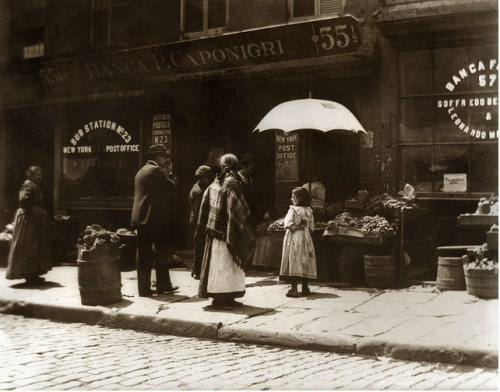
Jane Jacobs was a community activist. She most famously fought against Robert Moses's proposed plan for the Lower Manhattan Expressway that would have destroyed a large part of the historic immigrant neighborhood of Little Italy. (This is where Jacob Riis took many of his photographs of tenement life on the Lower East Side.) Many families and businesses would have been displaced by the construction of the expressway. For Jacobs, the chaotic and beautiful life of the sidewalks in such neighborhoods was the heart of the city.


Wednesday, August 31, 2011

Shanghai, shanghai


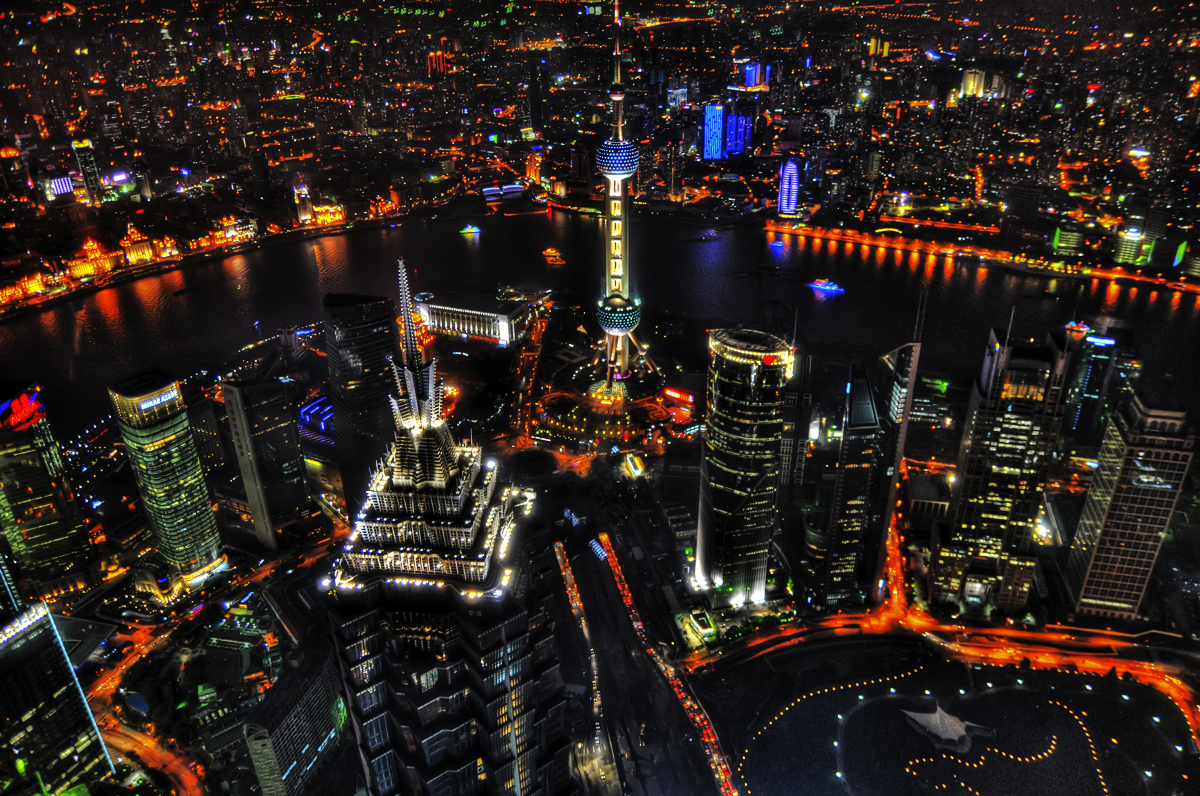
Shanghai is one of the largest cities by population in the world. During the last decade of the booming of Chinese economy, it has flourished to a global city, exerting influence over finance, commerce, fashion, technology and culture.


Today, Shanghai is the leading financial center in Asian continent; it's own stock market Shanghai Stock Exchange ranked their among worldwide stock exchanges in terms of trading volume; it has over 20 million residents; it just held the World Exposition in 2010; it has over 13 metro transportation lines; ATP World Tour took place in Shanghai; F1 took place in Shanghai; Transformer 2 was shot in Shanghai......


However, under the shade of prosperity, Shanghai is a vicious magnet, attracting migrant laborers to come and contribute their life to the venal magnates. Let's look at some facts and statistics. Shanghai has a bigger population than Australia's. Out of the 23 million people in the city, 9 million of them are migrants from all over the country. Then, out of the rest of 14 million residents, only 35% of them are natural Shanghaiese, born in Shanghai and speak Shanghaiese, a local dialect only spoken in Shanghai, distinct to Mandarin Chinese. Similar to the immigrants culture in New York City, a foreign is formed by various groups of emigrants in Shanghai.


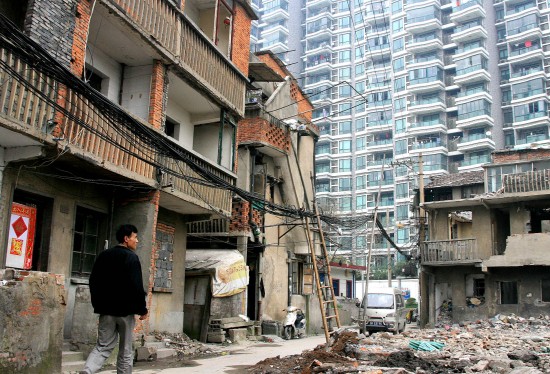
This is a typical tenement, maybe even a fancy one since it has only one storey and a yard. Behind the tenement we can see that there is a silver modern building. In all the images one can find online, Shanghai is composed by a medley of uneven fashionable buildings, but here in this picture there is only one. On the second door from the right, a red Chinese letter is written on it: "拆“, which means demolishing. The tenement we are looking at here is about to be pulled down, or already pulled down by now. Because another groups of modern building is about to be constructed here. It means that the migrant workers living in the tenement are forced to leave and find somewhere else to squeeze in.


shanghai
v. to put by trickery into an undesirable position


Other than the "Shanghai" you can find here, (just kidding, here). There exists the invisible "shanghai" behind it. It locates at every blind spot away from the city's resplendence. Shanghai, lures these migrant workers with its exhaustible opportunities and limitless wealth, cram them into slums and extort cheap labor from them. No "rags to riches" story could possibly blossom there because "infants" are already smothered in the "nursery". While the urban city expands, these "ugly" tenements are torn down and workers are driven out from their home. The city's improvement is based on the sacrifice of diligent, innocent workers. Once a worker offered all his labor to the city, the city repels him, leaving him no opportunity nor even a shack for him to live. Behind the glory and splendor, the human nature of greed and hideousness forms the invisible city - shanghai.


After all, where can he go?