Monday, October 1, 2012

"Looper" - A Dystopian Vision at its Finest


In the new movie Looper, starring Joseph Gordon-Levitt and Bruce Willis, director Rian Johnson gives his audience a new look at a dark, dystopian future molded by social decay and organized crime. Cities are totally corrupt, controlled by mobsters and hitmen, and poverty and homelessness run rampant through the streets of not only Kansas City, where the film takes place, but the entire world.


The premise of the movie is explained bluntly during the opening credits of the film through Gordon-Levitt's narration. The present time is 2044, and although time travel hasn't been invented yet, it will be 30 years from now-in 2074. The practice is promptly made illegal by the government, but mobsters use it in order to send their enemies back to the past at a specific time and place where they can be quickly and quietly killed by hired hitmen known as "loopers." In order to avoid any "loose ends," the loopers are eventually  forced to kill their future selves, which is known as "closing a loop." They are then given several bars of gold, and allowed to live theirs lives as they please until they are sent back to the past and shot by their younger selves. However, protagonist Joe (Gordon-Levitt) throws himself and his mafia-bosses for a loop (hehe) when his older self (Willis) manages to escape and avoid his murder. The film's plot revolves around young Joe's plight to capture and kill old Joe, and old Joe's equally desperate mission to save himself and his future wife.


The movie, while carried on its twisting, creative plot and excellent actors, would not be nearly as poignant without the background of its grimy, ruthless city. The city becomes like a character itself, and a most vicious one at that. Two of the most poignant scenes take place only about 10-15 minutes into the film, and revolve around the city's descent into a murky underworld. A quick shot shows a flat expanse of asphalt covered with scraggly looking people both standing around and sitting under makeshift tents. A line of people wait to board a bus, and a dirty man comes up and takes another man's belongings (two meaningless looking plastic bags) before sprinting away. When he realizes what has happened, the robbed man calmly takes a gun out of his pocket and shoots and kills the thief with an air of non-nonchalance. No one around reacts to what has happened-no one even looks up or pretends to care. This sort of raw violence  is evidently an everyday occurrence in the city, and has molded its viewers into apathetic animals. In another scene, a drugged-up Joe drives his equally wasted friends around the dark city in his flashy sports car-killers and other men of violence are obviously very high in status in this reality. Tripping and with spotty vision, Joe stops his car just inches before running over a tiny, dirty, lost-looking little boy playing soccer in the street with his friends. A filthy white wife-beater hangs off of the boys' scrawny shoulders as a chorus of "shit, man!" and laughter come from Joe's friends and the boy stares silently into the eyes of the man who almost just killed him.
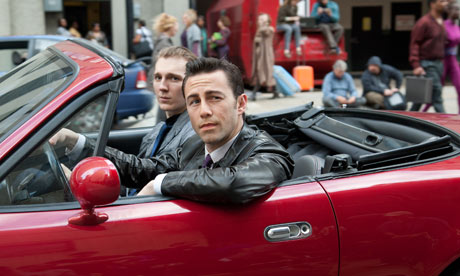

These two scenes and the countless other images of a lost and spiraling city really shaped the film into a bleak and harrowing gem. As Jay-Z raps in "Empire State of Mind," "cities is a pity/half of y'all won't make it"-in this film, the cities are more than just a pity, they breed killers, and unless people conform to that standard of violence, they too won't make it.


Austin City Limits: More Than a Music Festival


When most people think of Texas they think of extremely conservative southerners with heavy accents, but despite popular belief, some parts of Texas (specifically its capital city, Austin) have sprouted a completely different atmosphere. Having lived in Austin my entire life, I've been exposed to Austin's counter-culture, but it wasn't until my first attendance of the Austin City Limits Music Festival in eighth grade that I was able to experience  further the amazing "freak show" that is Austin, Texas. The thing that most struck me about my first experience at ACL was the huge amount of diversity among those in attendance. Whether you're looking for blues, country, rap, electronic, indie, rock, or whatever, ACL has it. While at first, I was a little confused as to why there were half naked people hula hooping at the back of The Black Keys concert, I began to realize that people like this were all over Austin, and that ACL was a place where everyone (and I mean EVERYONE) in Austin could come to listen to awesome music and "show their true colors." With tons of artists ranging for Bob Dylan to Kanye West, ACL has something for everyone. No matter what kind of quirky music, fashion, art, or just about anything else you're into, you'll find it here. In addition to the incredible music and concerts, there are countless tents set up around the festival to display the best of Austin's fashion, art, technology, and all over culture. So  even if you're not into music, you're in luck! There are tons of fun activities to take part in during ACL including an outdoor food court in which anyone can enjoy some of Austin's best food at stands including Amy's Ice Cream, Mighty Cone, and Sweet Leaf Tea just to name a few.
While the Austin City Limits Music Festival has only been around since 2002, Austin City Limits began in 1976 as a television show that aired various music video from Texan artists, and has since expanded into one of the longest running concert shows on television. The ACL Music Festival attracts people from all over the world and has not only increased Austin's popularity, but has also largely boosted the city's reputation as the "Live Music Capital of the World."
 While ACL is primarily a music festival, it creates a sort of paradise in which anyone can come (for the price of a $200 three day ticket) and experience the best aspects of Austin. Whether you're eager to join the movement of earth-lovers by carrying around a recycling bin and picking up trash, discovering the next big technologies in the Google + Tent, or just trying to enjoy some of the great music, the Austin City Limits Music Festival surely won't disappoint.

Hairspray: Baltimore in the 60s


The musical Hairspray portrays the atmosphere of Baltimore in the 60s. Tracy, the main character, shows a strong sense of pride for her city. In the song Good Morning Baltimore, she refers to the sounds of the city as a “symphony,” and says that “every day is like an open door.” In her view, Baltimore encourages Tracy to achieve her goal of being a movie star.


In fact, Tracy uses the atmosphere of Baltimore in the sixties to encourage her mom to dance as well. In the song Welcome to the Sixties, Tracy tells her mom to “look around” because “everybody’s groovin’ to a new sound.” The atmosphere of Baltimore in the sixties contributes to the development of Tracy’s mother as well as Tracy.


The racial segregation present in Baltimore in the sixties adds to the culture of the city and the way the people who lived there are shaped. In Run and Tell That, Seaweed addresses his struggle with stereotypes.
I can't see
Why people look at me
And only see the color of my face

And then there's those
That try to help, god knows
But always have to put me in my place
Hairspray challenges the racial discrimination that was so prominent in the sixties. Through the interracial relationship of Penny and Seaweed, the director portrays that race should not be something that characterizes a person. In The Intuitionist, Whitehead also portrays the absurd yet present color barriers. When Pompey receives a promotion, he is also kicked in the butt to remind him that he is still inferior to the white employees. Segregation greatly impacted the environment of cities like Baltimore during the this time and changed the way people in the city viewed each other.


More information of Baltimore’s Racial Segregation:

Hairspray: