The class blog for Mr. Dean's senior English elective at St. Stephen's Episcopal School in Austin, Texas.
Tuesday, September 27, 2011
The Capital Who Watches Over All

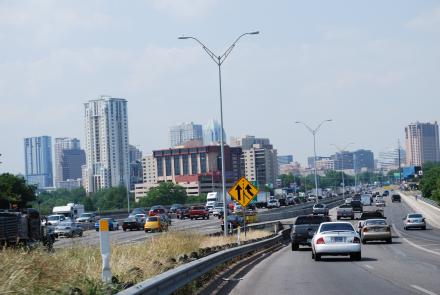
The Biggest Parking Lot
Its 5:30. I’m trapped on I-35, known at the “worlds’ largest parking lot”. I have been stuck in traffic for over 30 minutes and I have to be downtown in less than 10 minutes with 3 miles left until I can exit…FML!
Traffic is part of our lives for those that live in Austin. Heavy traffic stimulates anger and frustration from many impatient drivers with a busy schedule. Traffic congestion is very heavy during the time of rush hour, from 6- 9am and 4-7pm on weekdays, as people are driving to and from work. Even though traffic in Austin is not as bad as other major populated cities like New York City, sitting in traffic is still very annoying.
In modern society, time is money. People are constantly running around: getting to work, getting home, going to school, picking someone up, having a meeting somewhere, going to the movies, etc. Therefore, speeding has significantly increased because people are always in a rush to get to where they need to be.
Interstate 35 is the most annoying place to be when there is traffic. There is no room to breathe. Joe Taylor a traffic reporter for News 8 Austin describes that I-35 is "designed for a small town, and [Austin] has grown into a very large city." Since 2000, Austin's population growth has increased 15.4 percent in 2008.
As the city of Austin continues to grow, the roadways become smaller and tighter during rush hour as more people are driving on the road. According to Katherine Gregor, a journalist for The Chronicles, "the metric used to document congestion is a road's volume-to-capacity ratio, which compares the existing volume of traffic (flow rate) to a street's real capacity." A capacity of .8 or lower means that there is less traffic. However, downtown I-35 is said to have a capacity of over 1.0! I-35 is not the only roadway in Austin with high traffic congestion: Loop 360, Mopac, and Lamar.
Austin's traffic continues to get worse because of the lack of an alternative form of transportation. Capital Metro is one form of an alternative form of transportation that helps to ease traffic in the city; however, this form of transportation is not very popular to the public. In addition, businesses and shops in Austin are often very far apart and it is only convenient to drive, rather then riding a bike or walk.
So what is The Austin Department of Transportation doing in response to driver's frustration to the increase traffic?
The Austin Department of Transportation is constantly readjusting the route of city buses to make it more convenient to the public. The city has also built a Capital MetroRail that runs from downtown Austin to the norther part of Austin. According to Robert Spillar, director of The Austin Department of Transportation, they are trying to build "new sidewalk and bicycle improvements and advocating that people simply drive less, both regionally and in town."
How does traffic affect Austinites?
Some of the obvious reasons are that traffic causes people to be late to their activities and makes people anger. However, traffic also plays a role in car accident. Many people become reckless drivers when they are angry and frustrated in traffic: changing to the faster lane or using the shoulder to cut through traffic. Traffic accidents are heard almost everyday on the radio (KLBJ) and Joe Taylor also updates his Facebook about the incidents. In addition, businesses are also affected by the traffic. High traffic in an area can cause businesses to lose valuable customers because people tend to avoid the cluster of cars.
Monday, September 26, 2011
Taipei Essential
We had already seen the other two big cities' story in Asia, Beijing and Shanghai, this time let's see another amazing city, Taipei, which is where I'm from.
If you Google image "Taipei" you will mostly get the image of Taipei 101 which is the most symbolic building in Taipei. Taipei 101 is as known as the Taipei World Financial Center it is a multi-purpose building, if you want to step out from the image of a serious busy city surrounding by skyscrapers and take a breath you can go on the top of Taipei 101 and view the gorgeous city view from the tallest point, and the beauty of this city will amaze you. But Taipei 101 is not the place I want to recommend today.
The layout of the main shopping area of the city is two main streets that enclose about four perpendicular side roads. One of these roads contains the gold souks, there is a men's street and women's street, and the last street contains Abdulah's Jewelry which caters to westerners as well as some electronic shops.
Rahima is filthy. Trash and oil marks cover the sidewalks and streets. The buildings are all a tan color covered in dust from a previous shamall. Many people live above their shops, so AC vents drip on to the pedestrians. Mangy ca
ts walk around, indifferent to the people. But what makes the distraught nature of this city interesting is walking into a gold souk or Abdulah's Jewelry. When walking in the heavy door the clean air is refreshing. The pail floor is spotless. Shiny gold hangs in the windows and along the wall in glass cases. Under glass tables white spotlights are delicately placed to enhance the sparkling diamonds inlaid in gold on the soft off white trays. It is amazing that those stores can have such beauty and richness inside while outside lies the dirt and chaos of the street and the honking horns of cars.When the time for Prayer approaches, all of the shops close up with metal blinders locked at the floor, the dirty streets are free of the chaos of cars and people that are now at the mosque. But it is still not quiet. Prayer call echoes through the streets. There are multiple mosques throughout Rahima. Most are simple square buildings with a tall standing minaret. There is one large mosque which is not a sore sight like the rest of Rahima. It has four minarets surrounding the large dome with a crescent moon on top. I have never been inside, but I have heard it is very pretty. Intricate designs adorn parts of the walls and there are areas of stained glass. Prayer call occurs five times a day: two thirty minute prayers and three fifteen minute prayers.
Video of Islamic Prayer Call
http://www.youtube.com/watch?v=0GiZPyII-hg
The Hierarchy of District 9

of classes. In a city, someone has to be on the bottom of the social/economic ladder. Smart Cities v. Jaywalking

The argument for smarter cities is well summarized by the author of the NYTimes piece, "that armed with enough data and computing muscle, we can translate cities' complexity into algorithms" and thus create a more efficient system for living. The basic argument of the NYTimes opinion article, though, is that a city governed by machines will always be inherently flawed, since humans are more dynamic and will never be entirely predictable. The author invokes the urban activist Jane Jacobs to make his argument.
Sunday, September 25, 2011
London (Bridge) is Falling Down
Most people are familiar with the song called "Our House" by Madness as a happy goofy pop song from the early 1980s. And it is. But, a lot of the music that came out of England from that period was more critical of London and the British Government. Songs from groups like the Clash, The Jam, and even the Sex Pistols, better illustrate the unrest and dissatisfaction among England's working class. These songs identify many of the conditions that made young people in London and other cities in England feel so alienated.
In the 1970s, England like many other countries, including the US, experienced a recession. Unemployment, inflation, and prices were high, which especially affected middle and lower class workers. Whole sections of London had become run down and even abandoned. An influx of immigrants from former British colonies, such as India and Pakistan, added to racial tensions. The general feeling in London was that England's best days were behind her and that she had little to offer younger generations.
In "London Calling," the Clash mentions that "Phoney Beatlemania has bitten the dust," meaning that the pride England might have felt about the Beatles can no longer cover up the country's real problems. The song lists some of these problems as clashes between police and youth, the decline of manufacturing jobs, drugs, and the fear of nuclear war. The singer's refrain that "I have no fear/'Cause London is drowning, and I live by the river" is an ironic acknowledgement of how few options existed for many young people in London in the 1970s and 1980s.